




The Orioles needed this.
The time for “slow and steady wins the race” was back in early June, which was the last time they had climbed to two games below .500. But instead of methodically building on a promising 10-4 stretch that ran through June 5, they won just one of the next eight series, dropping back to a season-worst nine games under .500 by July 8.
In practical terms of trying to justify president of baseball operations Mike Elias buying and ownership pumping more resources into this year’s Orioles before the Aug. 3 trade deadline, the math was beginning to look bleak and time was running out.
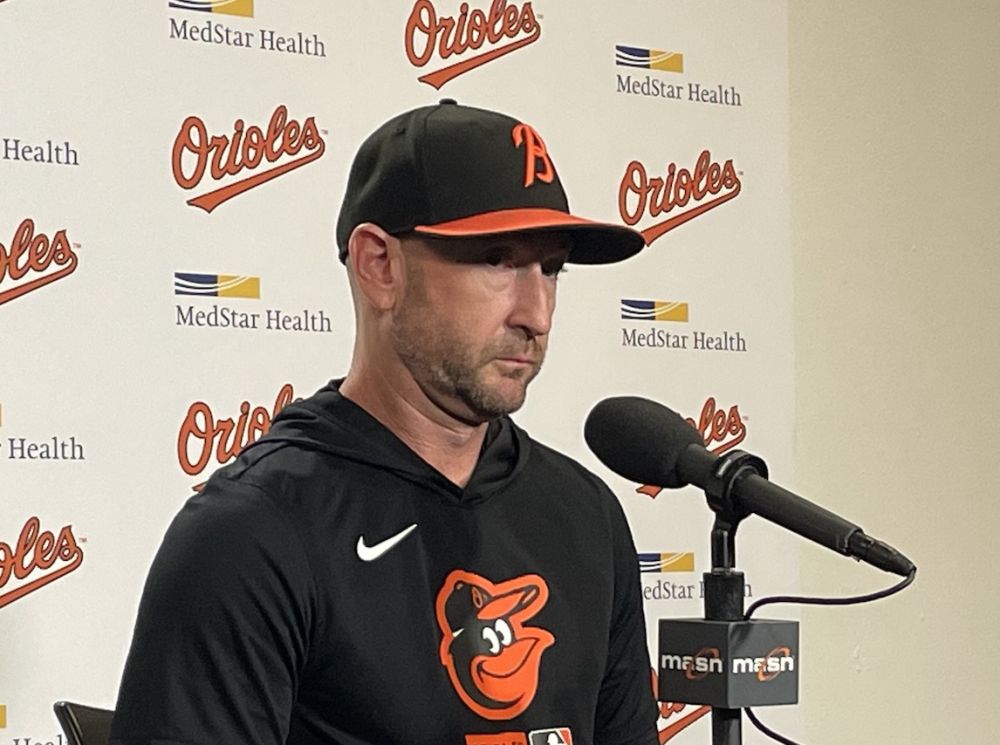
Yes, they had to get hot before the All-Star break and sustain it on the other side to be taken even semiseriously as a playoff contender. Seven straight victories and back-to-back sweeps qualify as manager Craig Albernaz’s club is right in the mix for a wild-card spot in the mediocre American League.
But what happens from here is all that matters. There’s no time for self-satisfaction when such a stretch of winning baseball still leaves you a sub-.500 team two weeks before the trade deadline. Such periods have been fleeting for more than two calendar years now as this marks Baltimore’s first seven-game winning streak since the final month of the 2023 campaign.
The Orioles can’t experience another backslide.
Nine of the final 12 games before the deadline come against clubs that entered Monday occupying playoff spots in either league. That stretch begins with Boston, who enters a three-game showdown at Fenway Park with a winning streak (13) nearly twice as long as Baltimore’s. A road series win over the hottest team in baseball would be a step up from sweeping fading Houston and last-place Kansas City and would command attention from the rest of the AL.















 8
8The Orioles have their flaws, but so does the rest of the league, which is enough reason for guarded optimism in the midst of their best stretch of 2026.
Contrary to what most expected in March or even late May, the starting rotation continues leading the way. On the heels of the latest outings from Trevor Rogers and Brandon Young against the Astros over the weekend, the Orioles rank fifth in the majors in starter ERA and second in starter innings pitched since May 22. And despite the absence of closer Ryan Helsley (right elbow) and the unflattering perception of the bullpen, the Orioles rank sixth in relief ERA over that same time period.
Just imagine where this team might be if a much-hyped offense weren’t so underwhelming. Even with the pitching being such a pleasant surprise, the Orioles’ fate still feels tied to how the bats fare the rest of the way with the awakening of Gunnar Henderson remaining an absolute must.
As is the case with any playoff hopeful, health will be critical down the stretch, and the concern level is once again on the rise in the midst of this winning streak. Not only did the Orioles lose third baseman Blaze Alexander to a fractured hand last week and shift Helsley to the 60-day injured list over the weekend, but catchers Adley Rutschman (wrist) and Samuel Basallo (right shoulder) are both dealing with injury concerns that forced them out of Sunday’s action. Even if not overly serious, that’s unsettling news for both the offense and the handling of the pitching staff.
(Update: Rutschman was placed on the 10-day injured list on Monday afternoon.)
A team already having multiple areas needing improvement can’t afford to lose any impact contributors the rest of the way.
It took more than three months, but the Orioles are finally playing their most exciting baseball of the season. The next two weeks will reveal whether it’s the precursor to a fruitful deadline and two-month sprint for a playoff spot or merely a temporary detour away from the malaise of mediocrity.
8No-brainer extension for Bradish
Even with the three-game sweep of the Astros, the best Orioles-related news from the weekend was starting pitcher Kyle Bradish agreeing to a five-year, $90 million extension through 2031.
This wasn’t a completely unproven Basallo signing an eight-year, $67 million deal less than a week after his major league debut or even Shane Baz inking a five-year, $68 million extension based more on perceived upside than actual major league results. When healthy, the 29-year-old Bradish has been one of the AL’s better pitchers since the second half of his 2022 rookie season, pitching to a 3.07 ERA over his last 76 starts.
Not only did Bradish finish fourth in AL Cy Young voting in his first full campaign in 2023, but he ranks 10th in the majors in ERA (3.03) among those who’ve made 60 starts since the start of that season. And though his first full season since returning from 2024 Tommy John surgery has included some hiccups, a 3.61 ERA over 19 starts is more than enough reason for optimism about Bradish moving forward.
Risk-free deals for pitchers don’t exist, of course, and there’s no guarantee that Bradish will stay healthy despite now being more than two years removed from elbow reconstruction. But short of being able to draft and develop pitching at an elite level, you have to bet on someone at some point.
Signing Bradish to what amounts to a three-year, $67 million deal for what would have been his first three seasons following free agency feels like a relative no-brainer. It gives him some much-deserved financial security and the Orioles a long-term anchor at or near the top of their rotation.