















We treasure our chats with future Hall of Famer Janet Marie Smith, who once again takes Nestor on a tour of modern stadium design and a Baltimore history primer that will remind you why you love Oriole Park at Camden Yards so much
Nestor Aparicio interviews Janet Marie Smith about her work on modern stadium design and Baltimore’s history. Smith discusses the unique features of Dodger Stadium, designed by Emil Prager, and its evolution over the years, including recent $100 million projects. She highlights the importance of continuous investment in stadiums to meet new codes and fan expectations. Smith also reflects on Baltimore’s urban planning success, particularly the reinvention of its waterfront and the impact of Camden Yards on the city. They touch on the changing retail landscape and the significance of storytelling in architecture. Smith’s firm, Canopy, focuses on urban planning and sports facility consulting.
- [ ] @Nestor Aparicio – Organize a Bougie Crab Cakes / Baltimore history and architecture day at Gertrude’s at the BMA with John Shields and invite Fran and Janet Marie Smith.
Dodger Stadium and Its Unique History
- Nestor Aparicio introduces the show and mentions upcoming events, including a Maryland Crab Cake Tour and a visit to Koco’s on August 26th.
- Nestor expresses his admiration for Janet Marie Smith and her contributions to Dodger Stadium and other sports venues.
- Janet Marie Smith discusses the unique history of Dodger Stadium, comparing it to other iconic baseball parks like Fenway and Wrigley.
- Janet explains the design influences of Dodger Stadium, including its similarities and differences with Shea Stadium, both designed by the same engineer.
Evolution and Expansion of Dodger Stadium
- Janet Marie Smith elaborates on the evolution of Dodger Stadium, highlighting its ability to adapt and expand over the years.
- She mentions the creation of premium seating areas like the Dugout Club and Baseline Club in the former foul territory.
- Janet discusses the ongoing investment in Dodger Stadium, including recent expansions and improvements to player facilities.
- She emphasizes the importance of fan experience and the continuous upkeep required to maintain the stadium’s relevance and appeal.
Janet Marie Smith’s Role and Contributions
- Nestor Aparicio acknowledges Janet Marie Smith’s extensive contributions to various sports venues and her role at the L.A. Dodgers.
- Janet reflects on her work with the Orioles, including the Sarasota project and the ongoing updates to Oriole Park at Camden Yards.
- Nestor shares personal memories of visiting Dodger Stadium and the impact of Janet’s work on the stadium’s atmosphere and fan experience.
- Janet discusses the ongoing nature of stadium upkeep and the need for continuous investment to meet new codes and fan expectations.
The Importance of Historical Context in Architecture
- Nestor and Janet discuss the significance of historical context in architecture and urban planning.
- Janet explains how understanding the history of a space can inform its future design and relevance.
- They discuss the evolution of retail spaces, from malls to open-air avenues, and the impact of online shopping on traditional retail models.
- Janet emphasizes the importance of storytelling in architecture and how buildings can tell their own stories through thoughtful design.
Janet Marie Smith’s Baltimore Connection
- Nestor asks Janet about her connection to Baltimore and her perspective on the city’s history and architecture.
- Janet shares her admiration for Baltimore’s successful reinvention after the decline of its shipping industry.
- She highlights the bold decision to build Oriole Park at Camden Yards and its positive impact on the city’s infrastructure and economy.
- Janet reflects on the importance of urban planning and the role of architects in shaping the future of cities.
Canopy and Its Mission
- Nestor inquires about Canopy, Janet’s consulting firm, and its mission beyond stadium design.
- Janet explains that Canopy was founded to help teams and cities adapt and evolve their spaces to meet changing needs and expectations.
- She credits Brand Weld for the growth and success of Canopy, highlighting her contributions to the firm’s development.
- Janet discusses the importance of technology in modern architecture and how it can enhance the user experience in various spaces.
Future Plans and Personal Reflections
- Nestor and Janet discuss future plans for Canopy and potential projects in Baltimore, including the Key Bridge and Pimlico.
- Janet shares her personal connection to Baltimore and her admiration for the city’s cultural heritage and urban planning achievements.
- They discuss the importance of community engagement and the role of architects in creating spaces that bring people together.
- Nestor expresses his admiration for Janet’s work and her contributions to the field of architecture and urban planning.
Nestor’s Personal Connection to Baltimore
- Nestor shares personal anecdotes about his experiences in Baltimore, including memories of East Point Mall and Memorial Stadium.
- He reflects on the impact of changing spaces and the importance of preserving historical significance while adapting to new needs.
- Nestor expresses his desire to explore Baltimore’s history and architecture in more depth, beyond the sports context.
- Janet encourages Nestor to continue exploring and learning about Baltimore’s rich history and the role of architects in shaping its future.
Final Thoughts and Future Plans
- Nestor and Janet discuss future plans for events and collaborations, including a potential visit to Gertrude’s at the BMA.
- Janet shares her excitement about the potential for new projects and the ongoing evolution of Canopy.
- They discuss the importance of community involvement and the role of architects in creating spaces that reflect and enhance the local culture.
- Nestor expresses his gratitude for the opportunity to learn from Janet and her insights into Baltimore’s history and architecture.
Nestor Aparicio 0:01
Welcome home. We are WNST AM 1570 Towson, Baltimore. Go feel like home here this week as we get the Maryland Crab Cake Tour out on the road. We will be um wearing my Koco’s gear. We’re gonna be at Koco’s on August the 26th. I will have a Raven scratch offs from the Maryland Lottery. I do love the Kiss bird from a logo standpoint, so I’m all down with that. Our friends at GBMC keeping me alive and well and healthy, and my A1C and my little my chart, all that stuff going on. My thanks to GBMC, also Farnan and Dermer keeping me comfortable because when it gets to be 110 next month, you’re gonna hope that you have your H track working the right way. 410 3677. Always love to spend time with Janet Marie Smith. She’s one of the busiest ladies I know with the canopy this and the Baltimore that and the L.A. that and we’ve been preparing for another World Series and all that. But she was very magnanimous last year in inviting me, keeping me out of the troubadour and out of the whiskey one more time, out of Dan Tanis for crying out loud, haven’t been there, but I have been to my favorite baseball stadium, Chavez Ravine, that she has made even more lovely. And you do know Janet Marie as much as I suck up to you with this Dodger Stadium, this and all this outdoor. Like I loved it even before you got a hold of it. You know that, right? Because I just love Dodger Stadium.
Janet Marie Smith 1:17
I know it’s Dodger Stadium is so unique; it really stands alone in the timeline of of you know sports venues. You got especially through a baseball lens. You got all these old guys, Fenway, Wrigley, and you know it’s now departed cousins of Shy, Kobisky, Ebbets. But there was that generation. Then you had the round parks, and somehow Dodger Stadium just missed that. Not somehow. It’s actually a great story of Walter O’Malley’s commitment to building the West Coast version of Yankee Stadium. And then Dodger
Nestor Aparicio 1:54
Stadium kind of looked like Shay, but not really.
Janet Marie Smith 1:57
No, not really. Though it’s though your question prompts this, it was the same engineer that did it. Emil Prager worked for both Walter O’Malley, the Dodgers’ owner, on what you know on Dodger Stadium at Chavez Ravine, and then he also worked for Robert Moses, who commissioned Shea Stadium in Queens, so they were designed by the same engineering firm, but I think it’s a real testament to them and to their respective clients that they are so so different. And you know, Shea, excuse me, Shea long Shea now gone was a much more artful building when it opened than than when it left. You know, when it opened, I didn’t know it then, but I can see from the photographs and people who described it. It had these little funky 60s medallions on it, some artwork kind of hanging off of it that was scraped off somewhere in the 70s or 80s, so by the time they tore it down, it was a shadow of its former self, which happened to a lot of those round parks. Actually, they started out having some artistic flair to them, and then got stripped of it over time. But back to your point about Dodger Stadium as a baseball-only park, it survived that era. You know, all the multi-purpose stadiums are now gone. But Dodger Stadium, even though it’s big, it had a lot of foul territory, like the multi-purpose stadiums, has proven to be very elastic. And in the area that used to be the bow territory, the Dodgers now have both the dugout club and the baseline club. It’s their most premium seating. It’s got clubs associated with it. It’s proven, even in spite of all the reports, that there was no way to expand the clubhouse because of the rock and the hillside. We, the Dodgers, have gone down not once but twice in the last 15 years, it expanded the clubhouse and created really first class player facilities. And then, of course, I often love to talk about my favorite part of it, which is the what Stan Cast and our the Dodgers president and CEO has had us do with the fan facing elements, building these new plazas and new front door and center field, two and a half acres of a party all the time. It’s new food, beverage, restrooms, kids areas. Listen, winning is everything, but so is taking care of your fans, and the investment that’s been made in Dodger Stadium. I think will give it a long life past its original 1962 opening.
Nestor Aparicio 4:40
Jan Marie Smith’s here. She’s the. I don’t know your. I don’t want to get your title wrong. I was gonna say executive vice. I. I know it’s got it. Is that right? I think I’ve got it right. I didn’t look it up. I’m just you know of the L.A. Dodgers, but also with Canopy. And I mean, I when when I asked my executive assistant clone to talk about you, I. I have to avoid your biography, the Camden Yards origin story, saving the warehouse, preserving preserving Fenway, renovating Dodger Stadium. So, like, I you know, I try to get into all of these things like that I’ve already covered. You can Google all of that. You’ve done all of that in the back of the. I mean, we we haven’t gotten onto my you should be in the Hall of Fame thing, but I’ll get onto that later. But um, I do think the Dodger Stadium thing’s fascinating for me because I think of you in regard to Oriole, and I see you, and I have coffee, and we’re around town, and you live here in Baltimore. But I mean, you’ve been at the Dodgers a decade and a half, and I think about the Sarasota project with Peter. Peter’s been gone a while now, yeah, and his family’s been gone. But when you had me and my wife and the man who saved her life out the night before Trump was elected. So it was November of 16. So we’re going back 10 years, and you were so proud of it then. And you had all the little bobblehead guides this, and the trash cans did this, and the walls did that, and the logos did this, and we, and it was. It reminded me of Sarasota. It was very throwbacky and whatnot. And then you invited me last year to see the center field, and you swore to me it was going to be newer and different, and it was. And I went that night, and I spent most of my time in the center field area, which used to just be sort of this. It’s
Janet Marie Smith 6:11
a parking lot.
Nestor Aparicio 6:12
Yeah, it was behind the the grandstand, and my dad and I found it in 1985. We saw Rick Sutcliffe pitch a Sunday night baseball game there at Shafez Ravine against the against the Dodgers. He was a Cub then, but because he was a Dodger before that. But I mean, I’m going back 41 years. I remember getting a two bagger back there, and I got the malt with the little stick, you know, at the concessions because they had they didn’t have that at Memorial Stadium back then. So I remember what it was and what you made it. But I remember you being so proud of what you did 10 years ago, and I keep thinking to myself, this continues to grow. And if the Orioles hired you back to come to Sarasota, you’d do a different thing there. It’ll be 20 years later. It’ll be updated. It’s sort of never ending, isn’t it? I mean, camping yards going through this bath now that the newer people are taking over, and I wouldn’t. I don’t even want to talk to you about it on the air because I don’t want to be mean-not to you, to them, but just in a general sense that these things, the upkeep part of this, and the vision for whatever the next Camden Yards and whatever the next thing’s going to be-it really is an ongoing thing, and there’s a caretaker part of it that you’ve taken on. And I wonder when the Dodger. My big point is: Does a Dodger project ever get done?
Janet Marie Smith 7:23
You know, I don’t think that I don’t know that it ever does. And it’s interesting in the in the years that I’ve been working on Dodger Stadium, 14 seasons now. Three times we’ve done projects that are in the 100 million dollar range, and the rest of the time, we’ve done you know things that sometimes it’s honeydew projects, but it’s not unlike your home. It’s a building. It needs upkeep, and that upkeep requires an investment. And some and and and often it’s not a one for one investment. Often it’s hey, we got to do better than the last time around. And better better can be defined as meeting new codes. It can be defined as meeting new fan expectations. It can be defined any number of ways, but it really doesn’t stop. I mean, I look back on the work that I did for Larry Lucchino and Tom Warner and John Henry at Fenway Park, and while that renovation had a really concentrated first 10 years, in part because the building wasn’t expected to last, and the then Red Sox had just kind of let it go, and in part because we were using historic tax credits, and we had a had had an incentive to do an investment within a finite 10 year period, but they’ve never stopped. I mean, the the Red Sox have never stopped investing in Fenway. I think the Cubs would say the same about Wrigley. Is a little bit of the difference that you see in in privately owned buildings, where you look in the mirror and you’re like, okay, this is what we got to do to to stay current. Sometimes the publicly owned buildings have a different dynamic, where where you know you you wait until government says it’s okay to spend money on it, but that’s the point’s the same. The building never stops. It never it should never stop. And the best buildings, not just ballparks, but whether it’s the library, the city hall, the you know the museum evolved to meet changing expectations.
Nestor Aparicio 9:25
Janet Marie Smith, the future Hall of Famer, is here. Yeah, she’s that Janet Marie Smith at Did Oriole Park at Camden Yards and Canopy here. If you see her around town, the Mississippi lady. Hi, how are you? Your neighbor anywhere in and around Mount Washington, up and down 83. We see you. I look you up and I Google you and I Wikipedia you. It says baseball executive, architect of anything, and urban planner above and beyond. Let I’m going to take you down a lane that I don’t think I didn’t even know I was going to talk to you about 10 minutes ago. But you said something really relevant to me about. Dodger Stadium and how it’s like home and it needs upkeep and it needs care and needs love, right? All right. Flash forward. Last week, I gathered some of my my my goons from Dundalk. They’re shutting down my mall. East Point Mall is about to go away, and and and I’m 57. I’ll be 58. I remember in the early 70s when it went from being a shopping center, and if I showed you the Heck Company and Hoshi Cones and the ads when it became a shopping center, oh, it was 60 sexy. I mean, it looks right out of South Beach with the you know the fonts and how it was presented as shopping center, not not the town square, not Essex on on the Avenue or Highland Town on the Avenue. This was a shopping center, and then after that, not good enough. The Penguins in the they had Penguins for 15 years, real penguins in Dun. You could come pet the Penguins. They had Safety Town, all of these kitschy 60 s, 70 s things that I played into. I learned stoplights, little houses in Safety Town. I got my plaque in 1973, and then it became a mall. And the mall, oh, we had to get the mall before Golden Ring got it, before Towson had it. We were the first ones to have Dundalk because we had the density of population, and most people lived there. Mall was like the sexiest thing ever, and now I’ve lived long enough to walk there with my son and tell him where Reeds used to be and where J.C. Penney went in and where the downstairs. I had a guy told me he worked at a head shop there in 1971 when it was a shopping plaza before Nixon went Schedule one, like literally these stories of this space, and I’ll bring some sports into this because Joe Irman said one time on in Memorial Stadium, walking through with his boys with Steve Sable on an NFL Network thing, and you know of his religion, he said he believed in the theology of a space. I could hear him in his Buffalo accent and what that space is, and and Janet Marie, I went over the other day, and I’m meeting with the Y about being a sponsor at Memorial Stadium, and I couldn’t go there for 10. I couldn’t drive by it, and I know you had a Pimlico relationship, and you’ve driven by, and I’m going to drive by to see that it’s gone. It’s just gone, and I think about East Point Mall being gone, and I’m thinking like that might break me up. I walked through there for the last time last week, and I know it’s going to be something else. But it’s been upkept, and it’s clean, and it’s not as ugly or terrible, and it’s functional. But it’s going to be something else. I think for all of us, whatever our mind space is, and you being the architect, which is the long form story telling way of saying to you, it’s hard to let go, you know, of a lot of things. And Dodger fans don’t have to do that unless they’re from Brooklyn. But when they come, that they go to their space. As an Oriole fan, I have a new space, and for my kid, it’s the only space he knows. But there is a thing about letting go of spaces and that they need to breathe and be something different. And that’s where your architect comes in, because anything you ever touched at Struve Brothers? Anything you ever touched, Camden Yards was a field. It was something else before. Well, the way this was
Janet Marie Smith 13:08
something else before. Yeah, you know, getting
Nestor Aparicio 13:10
our head around that help me get my head around them. Take it my mall, Janet Murray, please.
Janet Marie Smith 13:15
Well, but I think the mall is a perfect analogy, though, Nestor, because our retail buying habits have changed, and actually, the mall is the perfect analogy. Once upon a time, we strolled up and down Main Street, and then Main Street was, you know, moved out to the suburbs, and so there was an attempt to recreate it in mall form. What could be better? It’s Main Street under a roof. It doesn’t rain. It doesn’t get hot. It doesn’t get cold. And then, then we got bored with that, and we went back to golly. What do they call the avenues? Yeah, the avenues. Thank you. The avenues. Now they’re open air again, but there’s control. There’s still control by a single something, and it’s so it’s it. And then online shopping has surely changed that. Now there’s almost no such thing as an anchor. Like what’s an anchor today? Because it’s not your department store. Typically, I still love them, but but everything they
Nestor Aparicio 14:13
taught you about this when you were young and like trying to develop malls or stadiums or architect things, all it was throwback stuff that you needed to understand the history to get to the future, right? Like, and that’s your whole game. That’s where you you suck me in. You bring me in. You you you know. You make me want to be a Dodger fan when I’m out there. You know. Well,
Janet Marie Smith 14:33
I I I love the way you’re describing that because these are two things. One, it just you’ve got to pay attention to your audience and to how they’re using the space and and how they respond to change. I mean, listen, technology 20 years ago meant calling your IT department to fix your computer. Technology today is surrounding us like we don’t even carry a separate technology. It’s like it’s like water, water and power. Like you wouldn’t build a building without it. You wouldn’t build a building without technology. And yet, how do we harness that? How do we use it? How do we respond to it? And much of what we try to do is help teams and and cities. You know, Canopy often, as a consulting firm, works for the public sector as well as the private sector, but much of what we’re trying to do is say, how can you take the investment that’s already been made in this place in what you’re doing and help it morph into and change with the times and feel relevant? And sports are sports bring us together. I mean, they just do. And history doesn’t have to bop you over the head. It doesn’t have to be a history lesson. It’s just a tether to something fun and interesting, and a reminder of our sort of cultural heritage. And who doesn’t love a good yarn, you know? So, like the baseball’s on Utah Street that tell the story of all those home runs hit out there, and the the where Ken Griffey Jr. hit the warehouse. Like the building can tell its own story, just allow it to do that. So the kind of history that we enjoy celebrating is storytelling. Is just kind of what what what ties us together, what brings us together.
Nestor Aparicio 16:20
She is an awesome storyteller. She’s telling the story of the L.A. Dodgers now, also the story of being. Are you really a Baltimorean? Do you consider your you consider yourself one of us, right? That’s I’ve been there since
Janet Marie Smith 16:30
- That counts, doesn’t it? Sure, I think
Nestor Aparicio 16:33
so. I think you know we’re at the point now, like in the 2026 thing. If you’ve been here since last century, I’m gonna. I’m just gonna. I’m gonna. You’re gonna get grandfathered in. Yeah, I like. I was born at Georgetown Hospital, 1968. January Spitzer. Let’s talk canopy for just a minute and just update me locally. I mean, listen. I cheer for you. I want you to build Pimlico. I want you to build the Key Bridge. I want you to build the New Camden Yards. I want you to build a like. I’m. I’m all about that. That’s not the reality. And you own a side business, a big business, a consulting business, and are known through sports and baseball. People don’t even know that you did Chelsea. I mean, you did. I Charlie Steinberg would be on, and he would tell me about you building Polar Park up in Worcester, minor league parks, Sarasota. People know that. But Canopy, I I know you designed this to be about more than just building stadiums and arenas. Update me on Canopy because I don’t know a lot about it, and I don’t know that my audience knows about. Yeah,
Janet Marie Smith 17:27
well, Canopy is based in Baltimore, so rah rah charm city. We’re just growing it one employee at a time, but we’re about a we’re about 20, and it’s something that we started largely at the encouragement of Stan Casten of the Dodgers, he’s like, “Look, this is crazy. People are calling you all the time for help, and for many years, the Dodgers would happily loan me out to help other teams. I mean, and even in Major League Baseball, we’re we aren’t we’re only competitors on the field. The rest of the time, we want to support each other on the business side, and it just happens so often, Stan said. This is crazy. You should start a business. And lucky for me, Brand Weld, who is the you know former executive with the San Francisco Giants, she had been my my colleague at the Red Sox when we were doing the renovation of Fenway, you know, 20 years ago, she gone to San Francisco, got in her MBA at Stanford, and then worked out there for 12 years on on Mission Rock, a $3 billion development adjacent Oracle Park, and Brand was moving moving to Baltimore, and always a
Nestor Aparicio 18:40
good idea. Always a good idea. Megan McCorkle will tell me that at Live Baltimore as they have their gala this week. So yeah. So
Janet Marie Smith 18:46
Fran is really the one who’s turned Canopy into the powerhouse it is. Well, I need to have
Nestor Aparicio 18:51
Fran on is what I need to do. Do
Janet Marie Smith 18:53
you should speak to Fran. I hear you know her.
Nestor Aparicio 18:56
Maybe you can make that happen. You know, it sounds like Fran would she like crab cakes?
Janet Marie Smith 19:00
Of course she does. I don’t think you can move to Baltimore without that. As a oh no, I mean I’ve already got
Nestor Aparicio 19:04
my line of menorah for her Boston clam chair, San Francisco dungeon is like just get her some real crab cakes. I got wearing my Koco’s gear. She’s probably already got her favorite coco’s. Yeah, I know.
Janet Marie Smith 19:16
We love our office. It’s really fun being along the Jones Falls, and I mean, just sort of your your point about cities and how they evolve. You know, the the 83 expressway is built right on top of the Jones Falls. The Jones Falls itself probably never would do that today. And underneath, there’s this unbelievable environment, and we love that one of our offices are in one of the old mill buildings, and all these fantastic restaurants that have cropped up. And you go and watch, you know, watch the water flow down the Jones Falls. You don’t have to go to the harbor to see water in Baltimore. It’s all around us.
Nestor Aparicio 19:54
All right, look, I love you so much. I’m gonna let this go and end because I got trade deadline. I got this. I got that. I thought of. I tracked you down because I’m doing baseball because it’s going to be football season here next week. I want you and Fran to come and listen. Here’s what I’m going to do: we’re going to do bougie crab cakes with my cousin John Shields at Gertrude’s at the BMA, and I’m going to do an art fart day. I’m going to have Joyce Bucci was my art teacher in high school, and anybody else I know that’s architectural or like smarter than me, and in your line of work. My wife’s an engineer, as an example. We’re gonna do a day over there where I bring you guys over, and we’ll do like he has a vegan crab cake. John does, you know, Chesapeake Kitchen. So we’re well. Let’s have some Baltimore fun. But I think what I’d love to do with you one day is just pretend you’re not who you are, and you didn’t build stadiums, and we’re not dodgering or red socking or any of that. And I would just love to talk for like an hour with you about what you know about Baltimore history and architecture. Because I think just you just on that topic alone. Because I know you’re interested in it. You’ve lived in it for 40 years. I’ve never asked you about it. Neighborhood to neighborhood, my God! If I just stopped the sports crap with you and we went to Baltimore, it’d be awesome.
Janet Marie Smith 21:06
Well, let me give you leave you with this nugget: it is exactly that that brought me to Baltimore because when I was in urban planning school in New York City, Baltimore was being held out as an example of a city that had successfully reinvented itself when industry left in the early 1980s. Baltimore was considered a model city that was being held out for the way that it said, “Oh, industry has moved out. The port’s no longer a valid economic engine. But instead of sort of bemoaning the loss of that shipping industry, Baltimore reinvented itself with the waterfront, Harbor Place, the aquarium, the science center, the convention center-all these things that we totally take for granted. We even take for granted now that Camden Yards and M&T Bank Stadium are downtown. But that was bold. And when I learned that the Orioles were going to build a new stadium downtown. My thought was that is bold because the Orioles were drawing 3 million a year when they were in downtown Baltimore, and it was taking advantage of infrastructure that was already in place, and it was feeding the restaurants, the hotel rooms. It was allowing people who had visit were visiting Baltimore for a baseball game to also go to the aquarium and the science center. Those things don’t change, and that’s. I think sometimes in Baltimore we take for granted what pioneers we were from an urban planning perspective, but that’s what brought me to Baltimore in the first place.
Nestor Aparicio 22:38
Drop the mic. Just give me an amen. That’s all. Just amen. That’s it. You know, namaste, Janet Marie Smith, the future Hall of Famer. Just because of that stuff right there, crab cakes, and I’m plugging Gertrude’s and the BM. Because I think I think I would be a better. I’ll shave. I will. I’ll dress nice. Smell good. I will be a better host with you ladies who are ruling the world over at the BMA, I love it in this artsy environment, and I’ll get John to do something totally bougie for me. He he loves it. By the way, his I’m a regular
Janet Marie Smith 23:13
there because there is no better place to sit than that sculpture garden.
Nestor Aparicio 23:18
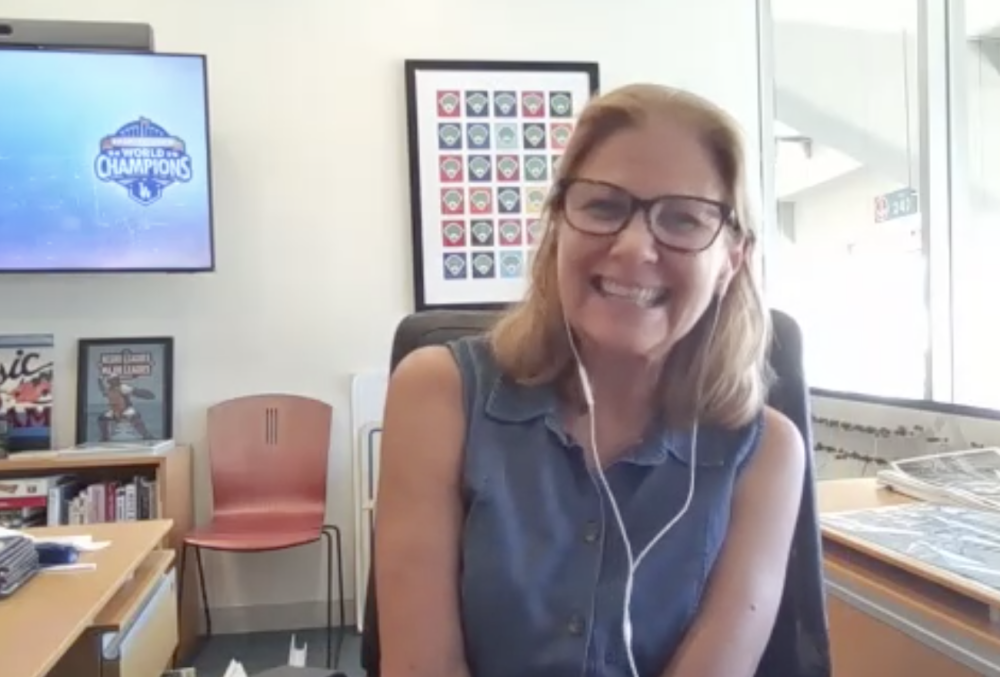
Amen to that. What happened is because my son-you always want your kid to be smarter than you, right? My kid married a Shield who is John’s cousin’s daughter, so my son married into crab cake royalty, Chesapeake cooking royalty with John. So we’re gonna have him buy, and I just think it’ll be, it’ll be a better show that way, and better than this Zoom, Zoom, Zoom. Even though you’re sitting with Dodger Stadium as the backdrop, and I love it. Janne Marie Smith is here. She executive vice president of the Los Angeles, the world champion Los. I gotta get that in because I’ve been looking at it over your shoulder the whole time. So you know, you you you like my old toys and my old fun stuff. You’ll like this. So I got. I’ve been collecting these 1971 belt buckles, and when I have Todd Radom on, who’s a mutual friend of mine? Oh, I know. I always pull these up. So I just want you to know that I have the old school 1969. This is my Dodger logo. I have my Oreo. I have them. I just picked up the Red Sox one yesterday. Literally, I get so excited. But look at my little Louis White Sox of the 60, late 60s. And this is my favorite: is the the the period piece logos of the 71. That’s fantastic. So I I knew you. Wait, that was
Janet Marie Smith 24:38
when they played at what do they call that? Um, Texas Stadium was that the the little the metal hot box. It was the metal hot
Nestor Aparicio 24:45
box. If you, I know you love to read. If you have not read Seasons in Hell, the best sports book I’ve ever read. It was on Radom’s bookshelf in Philly a couple weeks ago. Written by Mike Shropshire. It is about. The early the senators leaving and becoming the Rangers, Billy Martin, Whitey Herzog, Rico Cardi, and a cast of 1000s. Fergie Jenkins, you’ll love it. Seasons in Hell, funniest sports book I’ve ever read. By the way, I just brought this out for you for the Dodgers. I don’t love it. I didn’t want to promote the Rangers, but I want to. I can’t wait.
Janet Marie Smith 25:18
Let me see that again. That is that is from the 70s, isn’t it? 6969, I recognize the the weight the the logo hasn’t changed, but the weight of the letters has changed.
Nestor Aparicio 25:31
She’s a font queen too, always an architecture and urban planner. Janet, it’s it’s always great to visit with you. Thanks for coming on. I enjoyed
Janet Marie Smith 25:40
it too. All right, we’re showing crab cake.
Nestor Aparicio 25:43
She’s back winning games with the Dodgers, and we’re trying to figure it out around here. Trading deadline. Any breaking news happens first on the WNST Tech Service. That is all brought to you by Cole Roofing and Gordian Energy. Crab cakes for all of my friends. We are Baltimore positive. Stay with