





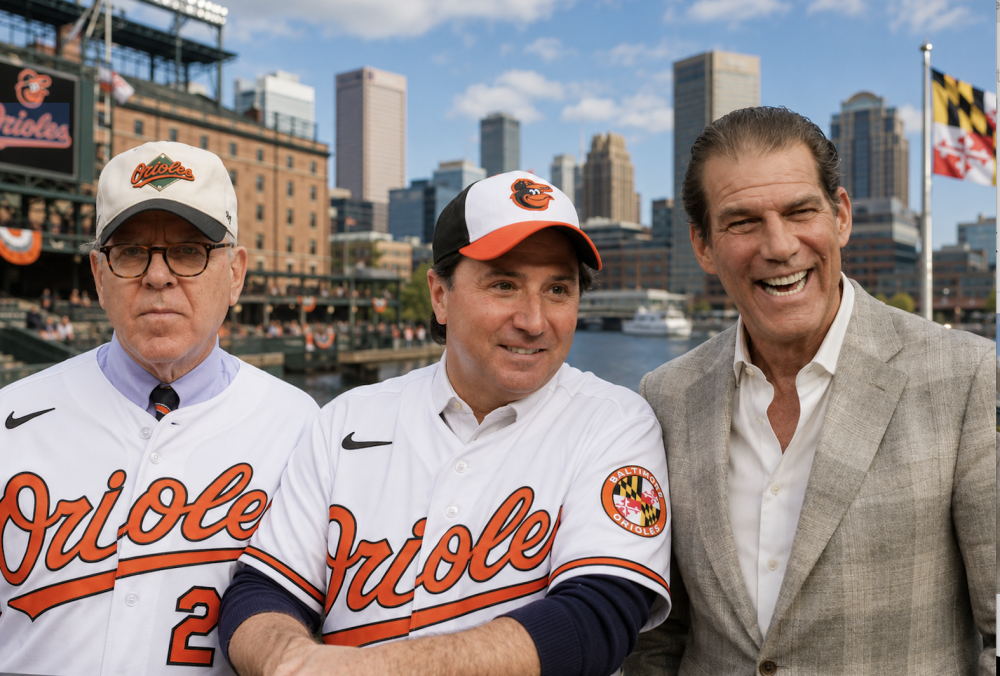
We always learn a ton of new information about leagues, franchises and ownership value and values whenever we invite Kurt Badenhausen of Sportico to give Nestor the new math of Orioles and Ravens franchise valuations and the upcoming MLB ownership risk that David Rubenstein and Michael Arougheti have taken in with a sport without a labor and cost certainty compass.
Nestor Aparicio and Kurt Badenhausen discuss the valuations and ownership risks of the Baltimore Orioles and Ravens franchises. Badenhausen, a veteran in sports business valuations, notes the Orioles are worth around $2 billion, while the Ravens are valued at $8.5 to $9 billion. They highlight the financial challenges and potential labor issues in Major League Baseball, contrasting it with the NFL’s stable financials. Badenhausen emphasizes the importance of institutional investors and the evolving media landscape, predicting a complex future for sports franchises. The conversation also touches on the historical context of sports team ownership and the impact of new revenue streams.
Maryland Crab Cake Tour and Guest Introduction
- Nestor Aparicio introduces the Maryland Crab Cake Tour, sponsored by the Maryland Lottery and GBMC.
- Nestor mentions upcoming guests, including Tim Kirchen, Buster Olney, Janet Marie Smith, and Marty Conway.
- Nestor introduces Kurt Badenhausen, highlighting his experience in sports business franchise valuations.
- Kurt Badenhausen shares his background, mentioning his work at Financial World Magazine and Forbes.
Historical Franchise Valuations and Ownership Dynamics
- Nestor and Kurt discuss the historical valuations of franchises, mentioning the Cowboys and Yankees.
- Kurt talks about the Washington Commanders and Dan Snyder’s purchase of the team.
- Nestor shares insights on the Orioles and Ravens franchise valuations, mentioning Steve Bashati and Art Modell.
- Kurt explains the evolution of franchise valuations and the increasing interest from institutional investors.
Challenges and Opportunities in Sports Franchise Ownership
- Nestor and Kurt discuss the financial challenges of owning sports teams, particularly baseball teams.
- Kurt highlights the potential for institutional investors to monetize sports franchises better.
- Nestor shares his experiences with various sports teams, including the Skip Jacks, Blast, and local colleges.
- Kurt emphasizes the importance of fan equity and smarter monetization strategies in sports franchises.
NFL Team Sales and Future Trends
- Kurt discusses the recent sales of NFL teams, including the Buffalo Bills, Carolina Panthers, and Denver Broncos.
- Kurt mentions the upcoming sale of the Seattle Seahawks and the potential for future sales in Baltimore and New Orleans.
- Nestor and Kurt discuss the impact of ownership changes and the potential for increased franchise values.
- Kurt explains the role of institutional investors and the long-term economic outlook for NFL teams.
Major League Baseball Ownership and Labor Issues
- Nestor and Kurt discuss the current state of Major League Baseball ownership, particularly the Orioles.
- Kurt highlights the disappointing start for the current ownership group and the challenges they face.
- Nestor expresses concerns about the upcoming trade deadline and the potential for labor issues in MLB.
- Kurt explains the potential for a salary cap and luxury tax in MLB, drawing parallels with the NBA.
Future of Sports Franchise Valuations
- Nestor and Kurt discuss the future of sports franchise valuations, including the impact of new media deals.
- Kurt explains the challenges of monetizing local sports content and the potential for new media partners like YouTube and Amazon.
- Nestor shares his skepticism about the viability of new revenue streams for sports franchises.
- Kurt emphasizes the importance of winning on the field and the role of media in driving fan engagement.
Historical Context of Orioles Ownership
- Nestor shares a story about Peter Angelos’s bid for the Orioles in 1993, highlighting the financial challenges he faced.
- Kurt recalls the early valuations of the Orioles and their high ranking due to the success of Camden Yards.
- Nestor and Kurt discuss the evolution of sports franchise valuations and the impact of new stadiums and media deals.
- Kurt emphasizes the importance of understanding the historical context of sports franchise ownership.
Impact of Media and Technology on Sports Franchises
- Nestor and Kurt discuss the impact of new media technologies on sports franchises, including streaming services and social media.
- Kurt explains the challenges of replacing traditional revenue streams from local sports networks.
- Nestor shares his concerns about the viability of new revenue models and the importance of maintaining fan engagement.
- Kurt highlights the role of new media partners in driving future growth for sports franchises.
NFL and MLB Franchise Valuations
- Nestor and Kurt discuss the current valuations of NFL and MLB franchises, including the Orioles and Ravens.
- Kurt estimates the Orioles to be worth around $2 billion and the Ravens to be worth $8.5 to $9 billion.
- Nestor expresses his confidence in Steve Bashati’s financial success with the Ravens.
- Kurt emphasizes the importance of understanding the economic factors driving franchise valuations.
Final Thoughts and Future Outlook
- Nestor and Kurt discuss the future outlook for sports franchises, including the potential for new media deals and revenue streams.
- Kurt highlights the importance of professionalizing sports franchise management and the role of business-savvy owners.
- Nestor shares his thoughts on the challenges and opportunities in the sports industry, emphasizing the need for innovation and adaptation.
- Kurt concludes by emphasizing the importance of understanding the nuances of the business of sports and the potential for future growth.
Nestor Aparicio 0:01
Welcome home. We are WNST AM 1570 Towson, Baltimore. We are Baltimore positive, taking the show on the road this week. It is the Maryland Crab Cake Tour back at it in Timonium. We’ll be at the OTB crab cakes. I’ll feel royal eat some crab imperial. All brought to you by our friends at the Maryland Lottery. I’ll have the Raven scratch off with my favorite Kiss bird on it, our friends at GBMC are put me out on the road this week to talk about all things medical and Farnham and Dermer have me covered as the comfort guys and our HVAC. I think Zach’s coming out this week. Luke is coming out. Alan, we’re going to talk some baseball and trade deadline this week. I have a huge baseball contingent coming on on the backside of the All Star game visit two weeks ago. Tim Kirchen will be here. Buster Olney will be stopping by. Janet Marie Smith stopping by. Marty Conway stopping by, talking about the business of sports. And as we get up on trade deadline, labor, and the National Football League season, it is an annual visit. At least I try to make it annual or biannual. I think he’s happy to hear from me when he does. He did this work for a long time for a place called Forbes. He’s now at Sportico. If you’ve ever seen any of the valuations of franchises, I don’t know how many years he’s been doing. We’re celebrating our 28th anniversary here this week. Kurt Battenhausen is here. He is our defending champion for at least a decade, decade and a half. We’ve been doing this together. How many years have you been doing sport business franchise valuations, Kurt Badenhausen? I
Kurt Badenhausen 1:26
got a couple years on you, Nestor. I joined a place called Financial World Magazine. My longtime partner in crime, Mike Ozanian, had just started franchise valuations at Sportico. So we did it at Financial World for a few years, and then both did our first one at Forbes together in 1998. And 1998,
Nestor Aparicio 1:50
where the Cowboys were worth, and they were number one, or the Yankees. What they were worth, couple 100 million. I got to say,















 8
8Kurt Badenhausen 1:57
it might have been the Washington Commanders back then. Of course, the Redskins. The Redskins were the most valuable franchise in sports for a long time. And Snyder,
Nestor Aparicio 2:05
what did he pay for them?
Kurt Badenhausen 2:06
Snyder paid. It was 800 million. I was going to say less
Nestor Aparicio 2:10
than a billion. I’m just starting at less than a billion. Definitely
Kurt Badenhausen 2:13
less than a billion. Just to give
Nestor Aparicio 2:14
people sort of where we are, and you know, I’ve written two books on the Ravens, Steve Bashati, in the first chapters of the beginning, what he paid, how he got in with Art Modell, how art went broke, and guys used to go broke doing this, dude. Right, like literally, you know, we were going to contract the twins, and the and you know they couldn’t find a place to put the expos, and they put him here, and it wound up really screwing up everything about this. But it didn’t cost the Angelo’s boys anything when they got 1,000,000,008 last year. So this is why Rubenstein gets in, right? It’s not the labor problem he’s going to have with Arigetti here in the coming months. It’s that we’ll always make money on it. Like that is the vibe on all of this, right?
Kurt Badenhausen 2:53
This is this is definitely a different vibe than the mid ’90s when we were doing this, and people didn’t even understand. So what do you mean you’re going to value a sports team. It didn’t even. They didn’t even understand what that meant. Like what the players are worth, or what you know. There was no. There was no such. Nobody ever thought this thing would be considered an asset class. And and here we are today. You got institutional investors piling in. The economics again. Franchise values just go up, up, up, up, and up. In terms of annual cash flow, they’re still not great businesses. Owning a baseball team, you’re not just swimming in profits every single. I often wonder when I go down
8Nestor Aparicio 3:33
there and see nobody there. I’m like, how are they paying people? And and I know they get national this and like what and spy. Like I’m not a dummy. I’ve been doing this a long time, but I do look around and say, “This isn’t being. It’s not reaching its potential in any way. In any way. Well,
Kurt Badenhausen 3:49
well, that’s why people are, you know, people smart people are buying and thinking we can monetize this better than it has been. We’re leaving way too much money on the table. This is; these have been run like mom and pop operations, and but they have so much just built up, obviously fan equity. I mean, and and squeezing more money out of those fans is front and center, and doing it in in a smarter way. Now, when we talk about teams not making money, I’m excluding the NFL. They all make money, and notwithstanding the Packers report from last week, which which was a a one off and super unusual situation, but NFL teams are swimming in annual profits because of that big national TV check.
Nestor Aparicio 4:36
Well, Kurt, I’ve been doing this my whole life. I mean, I remember with the Skip Jacks and the blast doing hand to hand combat. I’ve worked for Coppin State. I’ve worked for Towson State. I’ve worked for Morgan State. You know, I mean, all of them trying to do dollar ticket nights. Loyola College, trying to get people down, bring the band in, like trying to create March Madness like activities, trying to create a soccer event, trying to put a concert on, like any of these things where they. Sell beer, have bathrooms, have insurance, have parking. They all have these potential. Baseball has more of the dates in the 80 dates to do this. But man, I go back to hockey with the Capitals hand to mouth. Try. I mean, all of these leagues were really. They had to be nice to the media. They had to be nice to the fans. They had to be nice to the business owners. They had to be nice to everybody to make it a community endeavor. I mean, the NFL is so jump that they were playing games in Brazil. Like, it’s not the business that Art Modell brought here, nor does it the valuation the same. So, which is where I was reason I brought you on was that the Seahawks are about to go for about $10 billion, and I’m wondering just where mr. Bashati is on all of this because you know he thought about selling this 810, years ago after the knee and Wembley and and and just all of it. He thought about getting rid of this. He was marketing it as such, and it’s only doubled in value since the last time he blinked, kind of sort of right.
Kurt Badenhausen 5:56
Yeah, I mean we see this step up every team sale. There aren’t a lot of them in the NFL because it’s a good business, so it’s an actuary event or some sort of scandal. That that’s when these teams come up for sale. Starting the Buffalo Bills, the Kool’s came in 1.4 billion. Then you see a step up to Carolina, sold for about 2.3. Same thing. Jerry Richardson got a little bit of a little bit of trouble with some HR things, then we saw a step up from there to the Broncos, 4.6, basically a doubling over a few years. Pat Boland had died. Dan Snyder again, HR issues that sells for 6.05, and that was in 2023. Memory serves me, and here we are, three years up 50 more than 50% to the Seahawks, which again was only a matter of time before it was sold. After Paul Allen died, $9.6 billion, and honestly, the you know the next team to sell, if if it is a team, Baltimore, Baltimore, I don’t think nothing. No, no teams are for sale right now, and I don’t think you’re going to see anything again, barring a sudden actuary event. I don’t think you’re going to see NFL teams sold over the next 12 months or even maybe 24 months. But the teams that people bring up, to your point, Baltimore, people think at some point Steve Bashati will sell. Nothing imminent, but you know, if you’re looking out at teams that could sell over the next 510, years, Baltimore and New Orleans are the two that people always bring up.
Nestor Aparicio 7:27
Well, part of it’s secession plan. Kraft has kids. I have I have Belson coming on next week. I’m reading his book about Kraft and about Goodell and and and about Jerry Jones and the families and the children, which is what the Steinbrenner thing was, right? Like, and all of it’s different. The the Al Davis thing still going on out in Vegas as part of the legacy that you fall into this money. The Angelo’s boys got squeezed out of this thing, and the Orioles thing. And dude, I haven’t had you on in a minute. Like, I don’t, I don’t even know the last time I had you on, but it probably was around the time Rubenstein was coming in three years ago, or whatever, and the real valuation, much like the Redskins Commanders, whatever we would call it at this point, it was such a depressed asset because the owners ran it into the ground. I mean, like to your point, Snyder bought the most expensive, and now winds up selling it at a point where like the stadium was trashed. The brand was trashed. The name was trashed. The Orioles, same thing. Camden Yards was falling apart. State’s giving them money. Everything I talked about three years ago was about land and towers and the battery. And we’re going to do this. We’re going to do that. We’re going to build that bar that they have in Philadelphia. And the part, dude, I don’t curse much here, but ain’t shit happened. Nothing’s happened here, and except these guys got in, they’re doing bobbleheads to themselves. They’re locking out the media. They’re pissing off the fans that are still left with pricing and all the corporate corporate nonsense that Katie Griggs has brought in here. Like it, it’s really a mess, and they’re about to have a labor mess here. So specifically, I’m not worried about Pishadi. He’ll get his. We’ll talk about his whether his team’s worth 12 in a minute, but the baseball thing is front and center. It’s why I called you because, like, they got this trade deadline. They have money out. They have huge debts. They’re not going to have to pay their players next year. The whole industry is going to go to war. I sort of. I’m old. I’m almost 60 years old. I’ve seen this happen three times while I’ve been on the radio, the last 35 years. So, like, I this is a really weird spot for these guys, and nobody’s allowed to ask them questions. But I wonder if they know what they signed up for, because I know Angelos didn’t 30 years ago.
Kurt Badenhausen 9:32
Yeah, I again all the momentum that this ownership group came in with, and you know, turning the page was going to be a new day, spend money. It hasn’t happened. When all these young talent that the club had expectations were, people were your fan base was pumped. No, no two ways about it, and and it’s got to be one of the more disappointing. Starts to an ownership group with with with all the good vibes and expectations that were there. We’re turning the page on the Angelos ownership tenure, and and it just hasn’t been there. And yeah, right now is a scary time to be a Major League Baseball owner. It’s clearly headed for games being missed next year. Both sides are talking tough, which is again not not unusual in these situations, but but owners seem more unified than ever on pushing a cap, and we I know that’s a third rail issue for the for the union. So again, I mean, you know a
Nestor Aparicio 10:38
lot, I know a lot. Is that happening? No, they’re they’re they’re not going to push a cap on the playoffs. There’s
8Kurt Badenhausen 10:43
no way they’re no way they’re going to push a cap. They they the again for for my standpoint, the best case scenario is is is something with a luxury tax with more teeth in it, more akin to what we’ve seen with the NBA. Second apron, second apron has really caused NBA teams to change how they spend money. When before Steve Ballmer needed to write $100 million check, he didn’t care. The Warriors didn’t care about writing $100 million luxury tax check. That tax check that was the cost of doing business, and they they flex their financial muscles. But now that going over the luxury tax impacts how roster construction. Well, that’s changed the game completely. Now people don’t just blow through the second apron, and so I think. Well, that’s the problem with baseball,
Nestor Aparicio 11:31
right? If they got a salary cap, the Dodgers and Yankees would just spend more money on hot tubs, right? Like or whatever scouts, right? Like it would just be that way, right?
Kurt Badenhausen 11:38
The the problem with baseball why they can’t? You know, everybody’s like, oh, just do what all the other leagues do. Do you know 50-50? It’s what the NHL does, what the NBA does, NFL does. Easy. The problem is the revenue disparity between Dodgers, Yankees, and the Marlins and Rays of the world is is you know you’re talking about 10x on local revenue, so that’s really hard to find what the right number is that everybody should be spending. Now they they narrow that spread with revenue sharing, but but baseball, the way it’s constructed, is just is just totally different. NBA, NHL, most buildings fill themselves up to you know 90% plus capacity. That doesn’t happen in in baseball. You’ve got the Dodgers selling more than 50,000 seats per game, and then you’ve got teams selling in the teens without the price, without being able to increase prices. So baseball’s headed for absolute war, and so. But now that that’s the pessimist. Now you look at the Padres just sold for $3.9 billion. I was going to ask
Nestor Aparicio 12:46
you if these guys just farted tomorrow morning and said we’re out, we don’t want a part of this war. Call my broker. Let’s get rid of the Orioles. Like literally, would there be at this point with the labor situation? They can’t do anything till they fit. Nothing’s going to sell. Nothing can be for sale. But are the Orioles worth more than what they? I guess they are. I guess they are, right? That because the state, because all the taxpayers put money in to build the stadium up, so they at least have that asset taken care. They got the first 700 million free, right? Literally.
Kurt Badenhausen 13:15
Well, they’re worth more because I mean, you look around the sports universe, everything is up in value. So if an NFL, and he got a
Nestor Aparicio 13:23
bobblehead out of it too, an
Kurt Badenhausen 13:25
NFL team is 10 or $12 billion, and you’ve got NBA teams are all now five six. Lakers sold for 10. Again, rising tide lifts all boats. I mean, this is this is what MLS has been riding all these years because you can’t buy, you can’t afford an NFL or NBA team, and you can’t even get yeah can’t get in the NHL or MLB. All right, yeah, I’ll buy my local soccer team because that only costs me $500 million. It’s helped WNBA teams, NWSL teams. I mean, it’s just sports as again this asset class. There’s scarcity, and when you think about well, I guess say they’re not making any more. I think MLB will ultimately expand, but they’re not making a lot more of these things. And you have more and more billionaires every single year. Baseball’s had 30 teams for decades now, going back to the Rockies and Diamondbacks. So the franchise is definitely worth more than the 1.7 they paid for it now. And I there’s a lot of money in in that corridor of Baltimore, D.C. Philadelphia, New York. You and somebody with the opportunity to own one a baseball team for $2 billion, you’d have people lining up at the door, even with what’s happening next year, because that will be that will be a blip. You know, in the grand, if you’re looking to own this thing for the next 20 years, losing a half seasoning of games and the money that will be lost with that, you will have a better economic model. If you talk to bankers, again, it’s pending doom and. 2027, but they look to 2029 with a little long-term viewpoint. Totally redone television situation with local and national. You know, a lot more local games going into the national pie. You’ve got more cost constraints. People think baseball, in many ways is an undervalued asset right now, and are looking at 2029 and getting there. Well, there will be pain, but then they start getting valued more like base, more like NBA teams, not not like NBA, not like NFL teams, nothing’s like the NFL, but more like an NBA team because of 162 games a year. It’s still very valuable content, but they got to figure out how to monetize
8Nestor Aparicio 15:45
it. One way they can do it is have all the teams be completely mediocre and keep the pennant race open, which they’re doing right now. Kurt Badenhausen is here. He’s with Sportico. No one in the industry is is is more attuned to valuations of of teams. He’s been doing all of this century and back into last century, just like us. Hey, we began august 3 of 1998. When did you do your first ones? It spring in 98.
Kurt Badenhausen 16:08
First, well, in the financial world, we did it back in the early 90s. Wow. Okay. First, first one at Forbes was December 1998.
Nestor Aparicio 16:17
All right. So we started August in 98. So we’re trying a long time. You and I have been at this, doing this. We’re
Kurt Badenhausen 16:22
both old.
Nestor Aparicio 16:23
Well, and and I would tell y’all at
Kurt Badenhausen 16:26
heart, though.
Nestor Aparicio 16:26
You know what? Let me let me tell my fun little story here because it involves Angelos, and I it’s literally chapter one of my book, The Peter Principles, on on Peter, and I was told this story by someone who was in the courtroom, and so I’ll leave it at that. But I did think I quoted this person anyway because he was running the whole thing. He was the banker, but nice silver-haired gentleman that I like a lot. When they were in the courtroom in 1993 in New York, was 150 degrees, and Angelos is in there bidding at a million dollars a throw, getting the sale price to 173 million dollars at the time for the Orioles. 173 million sold it for 1.7 billion. So walk off Grand Slam for the boys, as I called it. And of course they were born on third base and thought they hit a triple anyway. So in regard to that day, mrs. Angelos was in there with Peter. Peter didn’t have two nickels to rub together. Really, he had just won a lawsuit. Money was coming in. He was nouveau riche. He drove a Cadillac and thought he had it made. He had never really had any money or done anything with his money, but he had. But he wanted to win this team. Made it local. We’re at Branchtown, so he’s bidding a million dollars up. And George Stamos was the guy bidding, and his wife was sitting there crestfallen, like could not believe that her husband, who didn’t even like baseball, was going to buy this baseball team with every nickel they’ve ever had and would ever have. They didn’t have 173 million dollars. They probably didn’t even have 20 million dollars of liquidity. Like literally, he bullshit his way all the way through this, knocked out everybody, intimidated and bullied everybody from the Dewitts to to Seelig to all of them. But same thing he did with the Mass. They bullied all of them and won the bidding. And Joe Foss, who was the banker, said to Peter on the like, mrs. Angelos is ashen in this room, cannot believe that her husband has spent 107. She never heard of 100. She’s a Greek woman from Highland Town, $173 million, and that came with 45 million in cash, but she couldn’t believe it, and he didn’t have the money. He literally did not have the financing, but he was he was using the the Cincinnati owner and the the St. Louis owners’ money because they were in on it at the time. Castanet Castellini, their money was in on it. Lachino was in. They were all in on it. Pam Shriver was in on it. Jim McKay was in. We were all in on it, right? So
8Kurt Badenhausen 18:54
Jim Clancy, Tom
Nestor Aparicio 18:55
Clancy, Tom Tom Dole, Tom Clancy, totally in on it.
Kurt Badenhausen 18:59
Yeah.
Nestor Aparicio 18:59
So Joe says to Peter, “Peter, we don’t have that much money. We don’t. We just bid. We don’t have the money. And Peter poked him in the chest, said, “Don’t worry, you’ll figure it out. That’s what he did. And mrs. Angelos walked out of there like sick that her husband bid on this, and now it’s worth how many billion? You know, to to your point, like the way we thought about this, and maybe even the way you thought about it when you’re writing before you were into Forbes back in the ’90s, thinking like, you know, they still got to sell tickets and things got into labor and all that, and now it’s just money for nothing. I mean, these guys had come in and destroyed the thing for three years, and you’re telling me it’s worth more money.
Kurt Badenhausen 19:44
Yep, yep. Well, I just look back. I just look back at our early valuations at Financial World. Orioles were second behind the Yankees during during those early because when when Camden Yards opened, I mean it was a mecca that sold out every. I mean. This was this was the greatest thing that anybody had ever seen. I mean, the White Sox built their opened their stadium just before. I
Nestor Aparicio 20:07
called it the Gateway Arch of Baltimore. Camden Yards was the Gateway Arch. It literally became the thing everybody needed to come and be a part of. I
Kurt Badenhausen 20:14
saw it. Yeah, I went there the first year. I was living in D.C. It was incredible. It was the place to be. And so they were they were for a couple of years there ranked second in Major League Baseball in terms of the most valuable franchises behind only the Yankees.
8Nestor Aparicio 20:27
I want to talk about Manford. Kirk Battenauz is our guest. He’s at Sportico. He’s a genius about all this valuation. I love having him on. When I do, I try to get as deep as I can get. And listen, I was with Eric Fisher last week and Barry Bloom. We’re at the at the Major League All Star Game. I’m having Kerchon on this week. Only all these different people across all of this. If I had Rob Manford on for an hour, and he could tell me and be really honest with me, does he really know what he’s doing? I mean, do they really do? Do them as a collection really know where this media is going? Do they have a metric for how many people are willing to pay them $20 a month to stream games and and get it here. And just in a general sense, do they have? Are they pie in the sky about what it’s going to take to turn this franchise around? I’m talking about the Orioles, but just the sport itself. I always feel like it’s rudderless. When I talk to the smartest people, they’re like, “Yeah, they’re just gonna bundle this, and they’re gonna they’re gonna RSN this, and they’re gonna local that, and bingo bango, everybody’s gonna subscribe. And I’m thinking, dude, I’m in a place where we loved baseball, and it’s just not it’s not gonna roll out that way. And I don’t know where they think their revenue’s coming from, and who the smartest person in the room is, and who he’s listening to about the future revenue of the sport, because I haven’t met anybody that’s explained it to me in a way where I would have confidence explaining it to you.
Kurt Badenhausen 21:48
Yeah, I, I, well, I will say, Rob Manfred definitely knows what he’s doing. He’s been at this a long time. He has overseen a lot of these labor negotiations. The TV question is crazy complicated. I don’t think anybody knows how ultimately this is going to land. It’s also existential for
Nestor Aparicio 22:10
them at this point, right? They’re pinning everything on it.
Kurt Badenhausen 22:13
They’re well, they’re pinning everything on kind of the well. I I think they’re pinning everything on this three prong approach where we solve the TV problem, we solve cost control problem, and then we solve the revenue disparity problem, and they’re all intertwined. But they’re three wildly hard issues to solve.
Nestor Aparicio 22:33
And then we’ll sell tickets.
Kurt Badenhausen 22:35
And then no, but I’m being honest with you. But the game, I mean, listen, the game’s got to be good,
Nestor Aparicio 22:41
competitive on the field. Available. The games
8Kurt Badenhausen 22:44
are good. I mean, listen, there is a ton of momentum in baseball right now. Attendance is very strong. TV ratings are very strong. There is a lot of interest in this game. I think the rule changes have made a huge difference. So I I think there’s a lot of opportunity, but again, those those three issues are very tricky because it’s not just players versus owners. Obviously, you have 30 owners who have very different ideas on what they want to be doing. The Dodgers are playing a totally different game than the Marlins are playing, or the Pittsburgh Pirates have been playing for 30 years, so they they have different they have different interests and different goals, and that’s always been a challenge in baseball because you have such disparity in terms of the businesses. It’s more it’s more like the Premier League, Manchester United is running a totally different game than Ipswich, so it’s so that’s the challenge ahead. I don’t, and I, I, if it was easy, they would have a solution already. To your point, they’re trying to figure out some way where they bring in more of the local games, and the cap, you know, the trade-off is you don’t have to write as big a revenue sharing check or something because the Dodgers and Yankees aren’t just going to give up more local inventory without getting something in return. So the Dodgers maybe don’t have to write $150 million. Well, they get the
Nestor Aparicio 24:11
playoffs every year in return. Really, I mean that’s really what they get.
Kurt Badenhausen 24:14
Yeah, and so again, this is there’s nothing easy about what like getting a bowl game every
Nestor Aparicio 24:21
year when you’re, you know, it’s what you get, right? Literally,
Kurt Badenhausen 24:23
the baseball has ideas on how they’re going to do this, but and it’s also the media environment is is changing so rapidly that you know to say what what the media environment’s going to look like in 2029, yeah, that that’s hard to say. We’re going to see consolidation. Everybody seems to think that there’s still a place for local RSNs. Baseball can’t handle the inventory for you know 81 home games for 30 teams. That’s just too much content. So there’s got to be some sort of you can’t funnel all of the content like the NFL. You can’t run an NFL. Where it all flows through the national, there’s just too much content, and they don’t want to do that seven days a week for six months. So, so there still needs to be some sort of local component. And what happens to does YouTube, you know, want to be in this baseball business? Does Amazon want to be in the baseball? Does Apple want to be in the baseball business? Those are all you know important questions. Those are the people that have the most money. They got a lot more money than NBC has, or Fox, or even ESPN. So it’s going to be, as we talked about, it’s going to be a very rocky three years to get to that point where you figured out the media, you figured out the labor, and you figured out the revenue disparity.
Nestor Aparicio 25:40
And I wasn’t disparaging Manfred. I’m disparaging the whole thing because listen, I’ve been on the air 35 years. In the beginning, it was we’re going to build a stadium, and it’s going to have a club level, and everybody’s going to want to come to it, and we’re going to have signs, and we’re going to have television, we’re going to sell ads, and we’re going to sell beer and parking, and and everything around. Then it was okay. It’s going to be television. That was new.
Kurt Badenhausen 26:00
That was revolutionary. Okay, and before that, it was just oh, we just have general admission tickets. Tickets,
8Nestor Aparicio 26:04
right? Exactly. Okay, so then then it went to television. Oh my God, this Yes Network. I mean, that was all of what Angelos was about with Masson, and we’re gonna have a a real meet. We’re gonna have television like Fox does, and 24 hours a day. Except we’re going to put pinochle on and log rolling and highlight and dog races, like literally gambling, gambling, gambling, gambling, gambling’s going to save everything. Kurt, I know you know that you’ve heard that one before. So gambling was going to save this big poppy with the hose. That’s going to be revenue, revenue. Who’s going to bet on baseball? Only apparently everybody lately. I never knew anybody. I’ve been around degenerate gamblers for 35 years. Running a damn radio station. Everybody bet on football. Nobody bet on baseball. They’re trying to change that. I I’ve heard all of this, and I will believe that people will stream this and all that. The one thing I’ll say that they really got going on for them is the game is a television game now. And I tell Luke this: is my press pass has been taken away. They let him go. The box on television and the certainty of the strike zone. I mean, you mentioned the shift and the pace of play and and the pitch, all the good things about baseball and the star players and Shohei and like all of that. The fact that it’s so good on television makes me not want to go to the ballpark because I can’t see the game as well. The game’s great on television because of the box and because of the the fact that you can tap your helmet and get it right and get replay right. All of that, that’s what they’re up against for me. But 20 bucks a month if they’re in the pennant race the first three months, $300 a year, $200 a year, $500 a year, 399 a game, 799 a game. I mean, I I don’t know I don’t know what their piecemeal is, but any of those ideas sound really bad to me. You know, none of those ideas sound like it’s going to Ford Pete Alonso to me. That
Kurt Badenhausen 27:49
that that that’s the problem because the economic the previous economic model was built on the 80 plus percent of subscribers that were paying for the RSN, but never watched a game.
Nestor Aparicio 28:02
Every house you went down your street, everybody paid Piero Angelo’s money. Not everybody watched the Orioles. That yeah, and I not many people overwhelmingly.
Kurt Badenhausen 28:10
Overwhelmingly, people didn’t watch the local baseball, even though the ratings were great. You know the 3.6 million
Nestor Aparicio 28:17
subs we got in Virginia. We’re getting $1.18 a sub.
Kurt Badenhausen 28:20
There you go. There
Nestor Aparicio 28:21
you go.
8Kurt Badenhausen 28:22
So those economics are really hard to replace, and we’ve seen it with with the teams that are losing their RSNs. You know, they’re getting they’re making 20 cents on the dollar, 30 cents on the dollar, and that was
Nestor Aparicio 28:35
existential to them, and it’s not there now. And I think that’s part of the negotiation, and that’s part of the Rubenstein Araghetti. They were never around when this thing was just printing money, and Peter was taking it all. Like literally, it was just printing $200 million a year, and it ain’t doing it anymore. And Peter’s boys got out, and they’re in Nashville counting the money. I’m wondering what these guys even know about any of this, because to your point, they just throw money at it. They’re money guys. They’re not baseball people at all. They don’t know any of this.
Kurt Badenhausen 29:03
Yeah, well, the the ownership basically ownership in all these sports has evolved a lot. You know, where it’s it is a lot of money guys coming in, it’s a lot of business guys coming in, and they’re looking to professionalize how these things are run, and not necessarily people that grew up on a baseball diamond, but they’re people that made tons of money in other businesses, now they can afford multi-billion-dollar sports franchises. But the
Nestor Aparicio 29:28
bananas guys figured out how to get people interested. That’s all, right?
Kurt Badenhausen 29:32
The banana guys, yeah, oh yeah, absolutely. But again, baseball has gotten people interested by almost any metric. Baseball’s engagement is up. I love that you say this
Nestor Aparicio 29:44
here, and that all of my national guesses because we just don’t feel it here, bro. You know what I mean? Like we really don’t feel it here, and we’re not playing the Tigers on Monday night. Nobody’s in Detroit. It doesn’t feel all this.
Kurt Badenhausen 29:54
I, I, I am talking across the sport. I get individual markets. There, there are problems. No, no question about it. I’m talking sport wide, any way you measure it. You got to win too. That’s part
8Nestor Aparicio 30:08
of it. You got to win.
Kurt Badenhausen 30:09
Winning helps, but again, let’s people figure it out. I mean, the the Colorado Rockies, probably one of the worst franchises on the field over the last 10 years. They get 35,000 people, 40,000 people to show up every game. Now, granted, it’s mostly just to hang out and drink. It’s the biggest bar in Denver, you know. But but people have figured out in a lot of ways. Again, I get I get the vibes in Baltimore are bad, but I I think nationally baseball has a ton of momentum. If if if you look across all 30 teams,
Nestor Aparicio 30:45
Kurt Patnazin is here. You can read his work at Sporto. Tell everybody about Sport. I want to learn a little bit from your perspective on it. Yeah, it’s an organization you’ve joined. Other people I know have been a part of it as well, and you’ve taken really the base of your work in this in this incredibly complex thing, evaluations of sports franchises, you’re known for that, but you do more than that too. We
Kurt Badenhausen 31:05
do a lot, yeah, right. Probably, probably 15 to 20 stories a month. You know, maybe one of those evaluations. But Sportico’s part of Penske Media, which owns a lot, many bigger brands than us, such as Variety, Hollywood Reporter, Rolling Stone, Women’s Wear Daily, South by Southwest. Maybe if you watch Ryan Seacrest, Dick Clark Productions is part of the company. So it’s a it’s a big organization. Had never done anything in sports. So Sportico launched in 2020, and would do a bunch of events and really dig in. A lot of veteran reporters joined up and dig into the nuances of the business of sports.
Nestor Aparicio 31:43
Yeah, I could have gone all down a World Cup rabbit hole with you. I could have dragged you into NFL season. You know, thanks for coming on. Thanks for always answering the bell. And the last thing: Orioles value right now, Ravens value right now. Give me a range.
Kurt Badenhausen 31:59
The Orioles probably $2 billion dollar franchise. The Ravens. I mean, if you look at the Seahawks sale, 9.6. Working on our NFL valuations right now. Ravens are, you know, probably an eight and a half, $9 billion franchise. It
Nestor Aparicio 32:13
was five last time I sneezed. You and I got together. That’s Steve Bashati. He’s drinking the good wine tonight.
8Kurt Badenhausen 32:20
Good to be an NFL owner.
Nestor Aparicio 32:22
Well, I think his wife endorsed it back in the day too, so I hope so and his kids as well. Kurt Badenowski can be found. It’s out at Sportico. We’re trying to get through the business of sports here this week and make it as impactful as it can be, especially in regard to the trading deadline and everything that’s about to happen in baseball here. We’ll have a lot of baseball this week, a lot of football next week, and meanwhile, rush is touring, so I’ll be disappearing around here this weekend to New York. Back for more. We’re Baltimore positive. Stay with