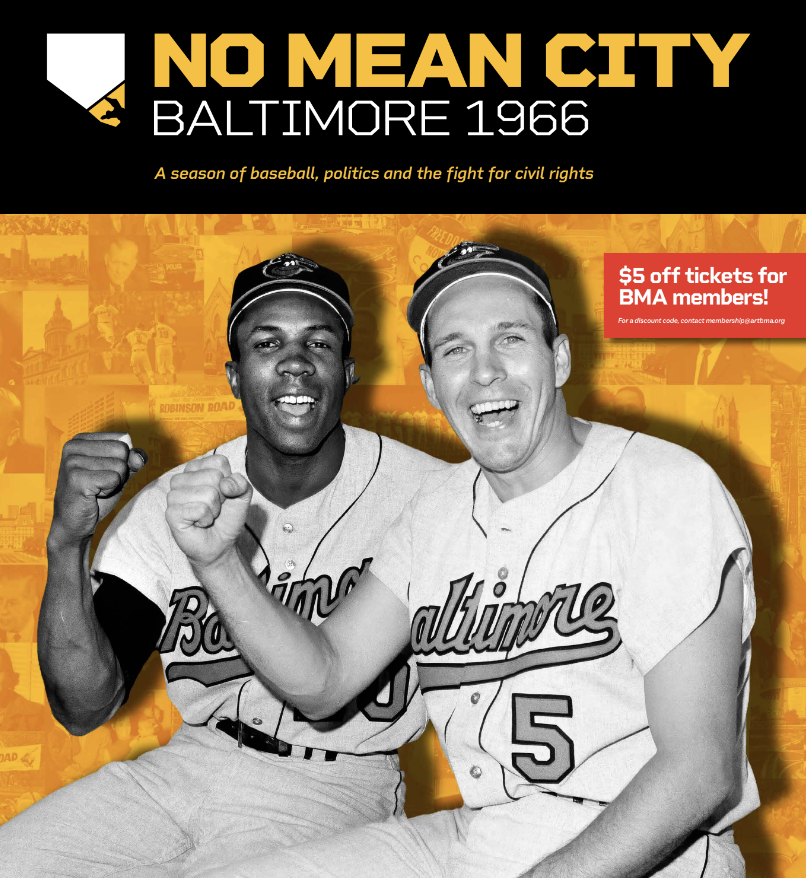


His next stage production at The BMA begins on March 5th and Dan Rodricks returns to Gertrude’s for the holidays to take Nestor back to his Aparicio roots with the 1966 Baltimore Orioles winning the World Series – and the realities of the city, race, politics and a colorful upcoming show “No Mean City: Baltimore 1966.”
Nestor J. Aparicio and Dan Rodricks discuss the upcoming play “No Mean City, Baltimore 1966,” which explores the historical context of the 1966 Orioles’ World Series win and the broader social issues of the time, including racial tensions and housing discrimination. Rodricks shares insights from his research, highlighting the challenges faced by players like Frank Robinson and the impact of Mayor Theodore McKeldin. They also touch on the city’s development, crime rates, and the importance of supporting Baltimore. The conversation includes personal anecdotes and reflections on the city’s history and culture.
- [ ] @Nestor Aparicio – Invite and arrange to have Ivan Bates appear on the show (coordinate scheduling and public appearance details)
- [ ] Schedule and begin rehearsals for ‘No Mean City, Baltimore 1966’ starting in January and prepare cast for performances March 5–March 15 at the BMA
- [ ] Organize a free student matinee for middle and high schools for up to 350 students on March 11 and coordinate school outreach and logistics
Gertrude’s at the BMA and Family Connections
- Nestor J. Aparicio introduces the show and mentions the candy cane giveaways at Gertrude’s at the BMA.
- Nestor talks about his family connection with John Shields, his cousin, whom he met through Dan Rodricks.
- Dan Rodricks and Nestor discuss their extended family connections and the significance of these relationships.
- Nestor shares his experience of driving through unfamiliar parts of Baltimore and discovering new streets.
Memories of Baltimore and Orioles
- Nestor reminisces about his childhood memories of the 1966 Orioles and their impact on his family.
- Dan Rodricks and Nestor discuss the significance of the 1966 Orioles winning the World Series and its cultural impact.
- Nestor shares a personal story about his father moving to Baltimore due to the Orioles and the racism his father faced.
- Dan Rodricks talks about the challenges Frank Robinson faced in finding a house in a white neighborhood in Baltimore.
Historical Context of 1966 Baltimore
- Dan Rodricks explains the broader historical context of 1966 Baltimore, including racial tensions and the push for open housing.
- Nestor and Dan discuss the role of Mayor Theodore McKeldin and his efforts to balance civil rights with community stability.
- Dan Rodricks shares insights from his research on the play, highlighting the complexities of the time period.
- Nestor reflects on the personal significance of the 1966 Orioles and their impact on his family.
The Play “No Mean City, Baltimore 1966”
- Dan Rodricks talks about the development of his play, which focuses on the 1966 Orioles and the broader historical context.
- Nestor and Dan discuss the importance of telling these stories and the impact they have on audiences.
- Dan Rodricks mentions the upcoming performances of the play and the efforts to engage students through free matinees.
- Nestor shares his excitement about the play and the personal connections it has for him.
Baltimore’s Development and Renewal
- Nestor and Dan discuss the ongoing development and renewal efforts in Baltimore, including the construction of new homes and businesses.
- Dan Rodricks highlights the positive changes in areas like Baltimore Peninsula and the impact of these developments.
- Nestor reflects on the progress and challenges of Baltimore’s urban renewal, emphasizing the importance of community investment.
- Dan Rodricks shares his optimism about the future of Baltimore and the potential for continued growth and improvement.
Personal Stories and Cultural Connections
- Nestor shares personal stories about his Italian heritage and his experiences with Italian cuisine.
- Dan Rodricks and Nestor discuss the cultural significance of dishes like Baccala and the challenges of preserving traditional recipes.
- Nestor reflects on his family’s history and the importance of maintaining cultural connections.
- Dan Rodricks shares his own experiences with Italian cuisine and the joy of discovering new culinary traditions.
The Role of Baltimore’s Institutions
- Nestor and Dan discuss the role of institutions like Johns Hopkins and the BMA in shaping Baltimore’s cultural landscape.
- Dan Rodricks highlights the importance of these institutions in promoting education, art, and community engagement.
- Nestor reflects on the impact of these institutions on his own life and the broader community.
- Dan Rodricks emphasizes the need for continued support and investment in these institutions to ensure their long-term success.
Reflections on Baltimore’s Past and Future
- Nestor and Dan reflect on the history of Baltimore and the challenges it has faced over the years.
- Dan Rodricks shares his insights on the importance of learning from the past to build a better future.
- Nestor emphasizes the need for community unity and support to address ongoing issues and promote growth.
- Dan Rodricks highlights the potential for positive change and the importance of collective effort in achieving it.
The Impact of Local Leadership
- Nestor and Dan discuss the role of local leaders like Ivan Bates and their efforts to address crime and improve public safety.
- Dan Rodricks shares his conversations with Ivan Bates and the strategies being implemented to reduce violence in Baltimore.
- Nestor reflects on the importance of local leadership and the impact it has on community well-being.
- Dan Rodricks emphasizes the need for continued collaboration and support from all levels of government to achieve lasting change.
Final Thoughts and Future Plans
- Dan Rodricks shares his plans for future projects and the potential for new stories and plays.
- Nestor reflects on the importance of these stories in promoting understanding and connection within the community.
SUMMARY KEYWORDS
Baltimore Orioles, 1966 World Series, Frank Robinson, Brooks Robinson, racial tensions, Mayor McKeldin, white flight, open housing, civil rights, Baltimore history, live theater, student matinee, Feast of the Seven Fishes, Italian heritage, urban renewal.


 8
8


SPEAKERS
Nestor J. Aparicio, Dan Rodricks
Nestor J. Aparicio 00:00
Welcome home. We are W, N, S T, am 1570 Towson, Baltimore. We are Baltimore, positive. I positively have the candy cane cash giveaways. Dan, they smell. They smell like Santa Claus. They smell like candy canes. We’re out here at gertrude’s at the BMA, this place. Nothing classes me up. Yeah, just being here class, yeah, it doesn’t everybody come in the air. I mean, Hopkins, there’s decays Gingerbread, there’s bourbon.
Dan Rodricks 00:31
Interior is beautiful. Even the gifts. I mean, you walk by the gift shop and it’s,
Nestor J. Aparicio 00:36
8you know, during this time of the year, I could promote your previous play about family and Portuguese and fire and Rhode Island and all that, and then about Baltimore, right? But, but turns out that you wound up introducing me to my own family here, that John shields, yeah, is my cousin, and I did not know that. When are you the first time I talked to you three years ago? You’re doing this play, yeah? Like, I know John shields out. He’s nicest man. I know he’ll be glad to do that. Be a great idea. We’ll do the BMA. And I come in and I find that I’m related to him. Now we’re like, at a sauerkraut and kobasa level, he and I, so on your mother’s side. No, my son married his first cousin’s daughter.
Dan Rodricks 01:15
Okay, I get it. Yeah, your son married John shields, first cousins daughter, daughter, okay, John shields, first cause that put you in the extended family. My son, if it was the beltway, you’d be on the outer son’s mother in law, it’s a big deal. Cindy, tell him, right? She already just said, if it was the beltway, you’d be on the outer loop.
Nestor J. Aparicio 01:35
All right, no, I don’t know. I’d be inside the beltway. Someone know the parkway. I know the parkway. Your extended family. Can I tell you something as a as a Baltimore transplant today, coming down here from Towson, I took argon drive over here, and I’ve never been on our guy like that. I’m aware of behind the stadium, which leads me into NO MEANS city, and your incredible play that you’re bringing here, then I’m going to stop everything.
Dan Rodricks 01:58
Well, we hope it’s incredible. So,
8Nestor J. Aparicio 02:01
I drove on the top side of Memorial Stadium. And I was a kid that took the 22 bus out of Highland town, so very familiar with the park and Clifton going down, you know, 33rd Street in the Alameda Montebello, but
Dan Rodricks 02:12
you were on the north side of the stadium,
Nestor J. Aparicio 02:14
coming over from Morgan above it, or whatever. But yeah, I came down the Alameda and made a right on Argonne, because, believe it or not, I was coming from my chiropractor, Dr Steve, up into Towson, and I put it into Google Maps, and I’m like, I wonder how it’s gonna send me to Gertrude. Because I’m thinking, how am I gonna go? Am I gonna park Perry Parkway? Gonna take lock rating to take? Yeah. How am I getting Charles from? How am I
Dan Rodricks 02:34
8gonna get here argon drive to where?
Nestor J. Aparicio 02:37
All over to Charles Right, right up here to North, right up by Hopkins. Oh, yeah, yeah, Guilford, basically, yeah. But I went from like, Alameda, East Baltimore kind of thing behind the stadium, or what I was called, to stay behind the why? Now, yeah, over here. And I’m thinking, How often in my life do I go on a street in Baltimore that you don’t know, right? And I was like, this is I’m gonna, I’m gonna take pictures
Dan Rodricks 03:01
of these hats I was on. I was on the street a couple years ago that I’d never been on, and I’ve been, you know, reporting and writing about Baltimore for almost 50 years. Guttman Avenue, yeah, where? Where Guttman Avenue? It’s, it’s near Exeter Hall, East Baltimore, like, south of 25th Street, but it’s, yeah, but you wouldn’t know it. And I never, I don’t know there was a Guttman Avenue. And then it turns out that John shields had, like, his grandmother or somebody lived on Guttman Avenue. Says, another John shields connection. So anyway, yeah,
Nestor J. Aparicio 03:38
so your play, you’ve done two different
8Dan Rodricks 03:41
places, yeah, the be the third one.
Nestor J. Aparicio 03:44
No mean city, Baltimore, 1966 I had a little bit of fun. I had my Oriole belt buckle. I whipped it out for John. Oh, yeah, I gotta be careful with this, because it was a kid’s belt buckle. This is a 1971 collection. So I got about 15 of these different teams. Now this is a Oriole belt buckle. You got Brooks and Frank on here, and I saw the Rubenstein when they signed Pete Alonso started throwing the Frank Robertson thing around, comparing it to Aparicio Dan because 1966 Orioles probably are the reason I’m breathing and alive right now, because it brought my father here from Venezuela with a certain short Venezuelan shortstop that came here in 1964 in a trade. So the reason I
Dan Rodricks 04:26
literally your father came to Baltimore with Louis, correct.
Nestor J. Aparicio 04:30
8My father, Louis brought two people to America with him. My father, my father’s brother, Omar. And Omar knew all the reporters in town because Omar was the wine Samuel a at the Chesapeake restaurant when you arrived during the early 70s, mid 70s. Yeah, wow. So yeah, wow.
Dan Rodricks 04:46
That’s how your father got to Baltimore. My father got traded from the White Sox, correct. Wow. I found a
Nestor J. Aparicio 04:53
story in one of the New York papers. One doesn’t exist anymore. One of the post American one of the names of the New York paper. You. Louie was quoted in there as saying that he was so much happier in Baltimore because he could bring his family to America. I don’t think Bill veck was helping him. I think hoffberger helped him. My stories on Frank is that hofburger helped that the Orioles helped him live in a better neighborhood that he had dealt with so much racism in Cincinnati that when he came to Baltimore, he wanted to live in a better neighborhood. Actually, do
Dan Rodricks 05:25
you know the story better? Yeah, it’s part of the play. Okay. Actually, he had less trouble in Cincinnati than he had here. Okay, says his wife, Barbara Robinson, spent a good amount of time traveling around with one of Jerry hoffberger, who owned the Orioles, one of his employees trying to find a house in a white neighborhood.
8Nestor J. Aparicio 05:45
That was a story I know. He was trying to live in a better neighborhood. That’s what I saw.
Dan Rodricks 05:49
He’s trying to live in it, according to the biography I read, that he didn’t have as much trouble in Cincinnati.
Nestor J. Aparicio 05:55
They weren’t he and white lining, effect of it, or just the overall
Dan Rodricks 05:59
8just finding a house where they wanted to live freely. They, I guess they didn’t face as much discrimination there. So here, Barbara can’t live there. He could not find a house to rent. This is the first year he came over. In 66 the trade was in December of 65 they and Barbara was looking for a house here during while Brooks, I’m sorry, well, Frank was at Spring Training, and she could not find a house in a white neighborhood that would rent to her March of 1966 to put Yeah, yeah around the we would have been that time yeah and but hofburger intervened. I think the mayor at the time, Theodore McKeldin, had something to do with it, and they ended up, they ended up finding a house in Ashburton, which was still, at the time, a mixed neighborhood. It wasn’t, it was a little bit black, a little bit white. Some Jewish people lived there. There was white fight had already started in the city, and white in the city was very segregated, and riots weren’t far off from that, right? Well, see, that’s the interesting thing. That’s why I got into this story about 1966 first, I was curious about whether the city could handle a play about I could write a play about the Orioles of 66 but it turned out there was a much bigger story there, because there was a lot going on in the city under this mayor, McKeldin, the last Republican mayor of Baltimore, that I just wasn’t aware of when I got to town in the 70s, the older reporters were still talking about the 68 riot. That was really bad in Baltimore, 68 but you know, there were riots in other cities in 6566 67 as racial tensions were heating up, but it didn’t happen here. In 66 it got little rough. There was a push for open housing in the city, and a lot of resistance to it. That’s part of the story of the play. I don’t want to give it all away, but what I discovered was there was a lot, lot more going on in Baltimore besides the Orioles winning the pennant that year. And of course, when you mentioned 66 to people who were around, then the first thing they think of is the Orioles winning the World Series four straight over the Dodgers. Right? They don’t think about all this other stuff.
Nestor J. Aparicio 08:16
Well, it marked my childhood, because Mike grew up in a house with the last name of Aparicio. My cousin played on that team. Yeah. Why you would my father love? Not my Aparicio, for my father to raise me, and he’s bald, yeah, not an Aparicio. Love the fact that I was an Aparicio, but he loved baseball, and the 66 Orioles were a much bigger part of my conversation in my child than, let’s say, either 58 or 59 Colts. And my dad revered them. Yeah, right, but 66 and there’s something about Kennedy’s assassination that really rocked my Father’s world. And my father lost a son in 69 but I always heard about this 68 riots. I was born in October of 68 at church home hospital. The riots were
Dan Rodricks 08:56
in April 60 they followed the death of Martin Luther King. April 6 through
Nestor J. Aparicio 09:01
the 14th of 68 went over a long time, literally a year and a half from the minute they won the World Series. 18 months later, yeah, was when the riots happened. Okay, so, and they were trying to
8Dan Rodricks 09:10
get money, and there was a different Mayor by then. To the mayor I I focus on in my play, McKeldin. A lot of people don’t know much about him. He’s kind of been forgotten. But he was kind of a cool mayor. He was he was a liberal Republican who cared about civil rights and tried to balance things, tried to push for open housing, and he met resistance there, and he was an interesting man. He had been governor for two terms.
Nestor J. Aparicio 09:39
What made him Republican during that era where they’re putting George Wallace up right, literally right on that side, Republican?
Dan Rodricks 09:46
No, no. Wallace ran in the Democratic prime.
Nestor J. Aparicio 09:49
8I’m sorry, but I’m talking about racism in the 60s in general. Yeah. How did a Republican get how was it popular here? I’m just trying
Dan Rodricks 09:56
to understand, well, the tradition of Republicans. Remember this. Party of Lincoln, right? Sure. So that’s sort of Yeah, 100 years later. So that’s like the remnant of that Republican Party, which was the party of Lincoln and Phil McKeldin and Eisenhower and people like that revered Lincoln and that heritage. So they weren’t all what you see today with Republicans which, you know, strident, extreme conservative here. I mean,
Nestor J. Aparicio 10:23
other than gracious people didn’t matter if you’re Republican or Democrat, you’re white, you were against that. Yeah, that didn’t draw the line.
Dan Rodricks 10:31
Baltimore had a long history of segregation, but they passed a law in 1910 that basically said White people can’t live in black neighborhoods, and black people can’t live in white neighborhoods. And it goes back even further than that, but actually it had a law passed in 1910 of formally segregating the city. The law specifically said that if a neighborhood was more than 50% white, a black person could not live there, and if a neighborhood was more than 50% black, a white person could not did I just repeat myself? I’m sorry. I meant the other way around. The other way around. Basically, that was not de facto segregation, that was statutory segregation. So city had a long, long history of that, but you know, it was, it didn’t really heat up until the 60s, when the push came with the civil rights movement. People said, we want to live better we want better jobs. The police force is all white. We need to have black police officers. And McKeldin, actually, this guy, when he was governor in the 50s, was appointing blacks to judgeships, to commissionerships, to various state positions. He was way ahead of the Democrats, really. And the remarkable thing
8Nestor J. Aparicio 11:43
that begets a Thurgood Marshall to happen, right? Yes, right, right, yeah, opportunities for African Americans in this Yeah, period of time, right, yeah.
Dan Rodricks 11:52
But, you know, get an education. But it was hard, yes, to get an education. It was hard, though. Another thing that’s revealing, at 1966 there was a governor’s race in Maryland, and the Democratic candidate was a was a racist Dixiecrat named George Mahoney, who ran against the idea of open housing that you that you under the Civil Rights Act, could not discriminate when you went to rent or sell a property to somebody. And Mahoney ran with the theme, your home is your castle protected. I mean, it’s like clear racist appeal.
Nestor J. Aparicio 12:30
This is right. Baltimore County came about in that era too. Yeah.
Dan Rodricks 12:33
8Baltimore County grew during that time. The city started, was just starting to lose population. In 66 the city still had more than 900,000 residents, but then you look at that history, we’re down to below 600,000 now, you know, and in the 70s and 80s, it accelerated even more.
Nestor J. Aparicio 12:51
I’ve had two Baltimore County Executive prospects on last week talking about people leaving Baltimore County now, right? Tax base schools, it’s shrinking. Where are they going? Yes, when I say Pennsylvania, Carroll County or, I don’t know, but Dan Rogers is here. The play is no mean city, Baltimore, 1966
Dan Rodricks 13:09
so it’s on stage in March. So three
Nestor J. Aparicio 13:11
plays for you in your this point in your life where you and I have poured out souls about sex, drugs and rock and roll, and Eric Bogosian, like, you know, and what your vibe as a thespian, as a writer, as a stage producer, and the people you bring in first play was you like, I got a soul for Baltimore, and I got a couple of stories that tell, I weave them in. You made me laugh. You made me cry. I brought everybody, my family, here two years ago. Then you did the courtroom thing because you had been a court reporter, and you had seen some wacky ish, and you wanted to write sort of poignant, somewhat funny, all of your stuff an edge to make you laugh and cry. That’s your your style. Where did this one come because I get together with you every six months and we break bread. We’ve even gone fishing together Rodricks and I had coffee together over 40 years. Where does the thing when you and I were fly fishing four years ago? Yeah, you’re thinking about the first play. You’re doing a second play. When does this hit you? Are you having a coffee one morning out in Western Maryland, or fly fishing and saying 66 Orioles play Frank racism. And then start to write from that, where’s that seed come from? Dan, well,
8Dan Rodricks 14:19
so I’m curious. Guy. I’m always curious about almost everything. And I’ve because I didn’t grow up here, I felt, I’ve always felt like there’s a lot to learn about Baltimore, right? And so I was curious about what else was going on in the city in the years just before the riots. You know, the 60 you mentioned the 68 riots, what was life like here in 67 and 66 and they focus on 66 and I, what I wanted to do was write a play more conventional than the first two. The first two are, like all my own stories, right? They were based on my columns, and this is a little different. These are events that happened when I was 12 years old, and I want. To show you something. All right?
Nestor J. Aparicio 15:01
So, you were 12 years old. You were in Massachusetts, right
Dan Rodricks 15:05
in Rhode Island. I was a Red Sox fan, right? So, but I was, I read Sports Illustrated magazine, actually had a subscription to Sports Illustrated and I remember, I remember, I was 12 years old, and it wasn’t really
Nestor J. Aparicio 15:16
8young Brooks looks, yeah, that’s it.
Dan Rodricks 15:20
But what hit me about this is this two guys named Robinson, one is black and one is white, and it to the and all this civil rights stuff is going on. These two guys are working together, and they’re gonna they won the World Series
Nestor J. Aparicio 15:35
in front of black and white people the stadium too. Yeah, mostly white, but yeah, fair enough.
Dan Rodricks 15:39
But it started to change. The reason hofburger wanted, one of the reasons they wanted Frank Robinson was because they wanted the Orioles to expand their fan base.
8Nestor J. Aparicio 15:48
They Well, the Red Sox weren’t taking on African Americans about that time, right kind of, sort of, kind of, nor the Redskins, there were teams literally in the 50s. And say, I mean art modell famously think about however you want. He was one of those people that was not a racist and really fought against racism with George Preston Marshall, different people that he had actually befriended in that fraternity. But this was Muhammad Ali, right? This was, this was 68 and, and, yeah, oh, yeah, okay, yeah.
Dan Rodricks 16:16
There’s a lot more awareness. But I was, as a kid, I was always struck by the fact maybe here people say, Yeah, okay, Brooks and Frank. We don’t know that story, but I was 12 years old in 1966 and I thought it’s, wow, that’s, that’s pretty cool.
Nestor J. Aparicio 16:33
The romantic in me would also say, well, plenty more. Played with Jim Parker, who played with Johnny you played with, yeah, Raymond Perry. You know, they were not, not integrated, right? I mean, Lenny Moore would give you some stories about being here and Big Daddy Lipscomb and all those kind
Dan Rodricks 16:47
8of things. And this is almost 20 years since Jackie Robinson, right? Sure. Okay, so yeah, or it never had a blast. This was the beginning of that with Frank Robinson and Oriole still at 66 had the fewest black players.
Nestor J. Aparicio 17:03
So in 1958 they were inclined to stink, but we can’t have black you know, we’re gonna white players. Yeah, I think of at the baseball cards, or that triandos And, you know, all of those players, yeah, and Louis was Hispanic, and they didn’t have a
Dan Rodricks 17:16
whole lot of that. No teams did
Nestor J. Aparicio 17:19
well, you know, if you were black and you were Cuban, they let you in basically, yeah, you know what? I mean, that’s how baseball worked for in some sort of weird way. You know about the color of your skin, Louie was okay, but yeah, in the 40s or 50s, not so much. But by the time 6060, so. So this happens, you’re thinking about black and white baseball.
8Dan Rodricks 17:41
So I started doing some research about 66 I wanted to write a more conventional play where it isn’t just based on my stories. I’m going to go back to that. By the way, I have two other plays in mind that are sort of like a one man show, telling stories. I am going to go back to that format because people like it. But I wanted to try this where I would, you know, create scenes and dialog on the play this, I serve as a narrator. Narrator, okay, yeah. Narrator, reporter, who I started off as a narrator, and then I slowly become a reporter asking questions, yeah. And we have, we have a solid cast and rehearsal start in January, and the play runs for from March 5 to march 15, right here at the BMA.
Nestor J. Aparicio 18:24
Well, I saw you. You know the cast and everybody get together so you’re in rehearsal. Now you’re
Dan Rodricks 18:28
Yeah, we had a table read. We start with a table read, okay, which is the first time you get everybody together that you’ve cast in a play, and they just read the script right straight through. It’s the first time you get to hear how these people, how it sounds, what the actors interpretation of the roles are, and it’s, it’s pretty exciting when you hear it,
Nestor J. Aparicio 18:45
8yeah, I’m gonna teach you AI, and you could pop it in there, and you’d know ahead of time, you know,
Dan Rodricks 18:49
yeah, what use chat, GPT or some to like, what play the different characters?
Nestor J. Aparicio 18:55
Yeah, it would just make the sounds for you. If you could have it, probably would Frank, if you Yeah, yeah. Frank’s voice in there, if you wanted to, yeah, well, it’s, it’s funky, man, yeah, no, but I’m a month into it.
Dan Rodricks 19:05
We if you got to try live theater, upset looking at your folks out there, I say you gotta come. Everybody to come to this point isn’t just my, you know, the experience of live theater. And, by the way, we wanted to do a student, student matinee. So because I think middle school, high school kids who don’t know any of this stuff. Well, you know, maybe they know some of it. We’re trying to get them there to because this is a history. This is a historic drama, okay? And so I’ve appealed to high schools and middle schools that bring their kids for free, trying to do a free student matinee for 350, students on March 11, so Wednesday matinee. So I
8Nestor J. Aparicio 19:44
can say the theme is Baltimore, 1966 race, baseball, the Orioles, politics and life in Baltimore, sort of what life was like. Yeah, yeah. And you know what the biggest look at your ornithologically?
Dan Rodricks 19:57
Yeah. You know, the biggest compliment I get from doing this is I learned something I didn’t know about Baltimore, okay, either from people who’ve lived here a long time when they say that that’s that’s cool, or someone who just moved here in the last 1020 years and didn’t know that and didn’t know this, that to me, that’s the biggest compliment I get for for these stories.
Nestor J. Aparicio 20:22
So last last night, I had my middle school music teacher, Mr. Calvin Statham, taught 59 years. What school was that? Halliburton middle and he’s turns 85 minutes last week, Christmas caroling. I’ll take you next year down in Edgemere, 300 people in a church. It only sat 200 all singing Christmas songs with Mr. Stadium on the piano. All his former students. He taught Pikesville, oh, he could give you stories about race. He was the only black teacher I had in hollybird and Archie Bunker Dundalk, 1979 and he said, yesterday, they sent me there for what he said, with you, whatever that means, they sent me there. So he taught 59 years in Baltimore County. And then a man named George Shulman, who’s also an East Side legend, taught 46 years as a science teacher in my middle school and high school. So I had George on about three years ago. He came to drug city to do the show because he was our baseball manager at Dundalk High School. He’s a scientist everybody. Pub Jordan, I never had him as a teacher. He wound up teaching 46 years, and he came on the show three years ago with Luke as a hoot, like they were just sitting in the way you sat with other people and hanging on my show. And Luke and I were talking baseball, and Georgetown baseball, you know, I went to the 66 World Series, right? What? Yeah, so I got my ticket stuff. I’m like, oh, once you hear that, somebody, you said to me, when you people that lived through that, yeah, George Shulman was on the show yesterday. I’ll remember everything about him, but the fact that he went to a World Series game in 1966 and adds a ticket stub that has some special value a kid named Aparicio. You know what I mean? It really does. Yep, I could not find my dad. 66 World Series sticks that looked a little I have them. I just couldn’t
Dan Rodricks 22:00
8find him. So this is a menu. This is a menu club for the hit
Nestor J. Aparicio 22:03
and run. I knew exactly what it was.
Dan Rodricks 22:07
And you should look at the prices of Hold on.
Nestor J. Aparicio 22:09
Hold on. Let me, let me, can I guess? Yeah, go ahead. Can I guess? All right, hold on. So what was on the menu here a crab cake in 1966
8Dan Rodricks 22:18
at the World Series, at the world the hit and run club during the World Series. World Series,
Nestor J. Aparicio 22:23
probably a buck and a half is what I’m thinking. Dollar 60 for corn beef. Yeah, sirloin steak. $4 Deluxe. Crap cakes. 252, 50, succulent crab meat done to a golden brown. Serve with tar, tar sauce.
Dan Rodricks 22:37
That’s, excuse me, in Boston, that’s Tata sauce. Yeah, that’s the gonna be the World Series price 250.
Nestor J. Aparicio 22:44
8$4 for the sirloin steak, thick and juicy, tender and Charo boiled to your taste, all entree served on a home plate that’s baked french fried potatoes. Look at that, man.
Dan Rodricks 22:53
All right, here’s a ticket. I want you to get him sandwich. 85 cents. I want you to guess what a ticket would cost to the third game of the World Series at Memorial Stadium. This is a lower box. Lower box, section, 3e, five, seat four. This is the mayor’s seat.
Nestor J. Aparicio 23:12
$9.50 12 bucks. That’s a real tilt. Don’t beat that ticket. That’s worth hundreds of dollars. It’s 12 bucks. 12. I said? What? I said? 1150? Yeah. You said, 950 Yeah. I have several of these myself. I have my dad’s ticket. So this is in the mayor’s box.
Dan Rodricks 23:29
Okay, go ahead and the this is given to me by Mayor mckeldin’s family. You should put this in glass, dude. This is, I know it’s really cool, and the magazine too. So this, I think, was the mayor’s placement place holder,
8Nestor J. Aparicio 23:42
Mayor McKeldin was so there was a McKell is a
Dan Rodricks 23:45
picture, but it’s a picture. Yes, there’s a picture. Chuck Thompson on the mayor’s that is Chuck Thompson, yeah. And if you open
Nestor J. Aparicio 23:54
up the inside or miss Agnes, ain’t the beer cold here? So, best wishes. Ted McKelvin Jr, Chuck Thompson, Ted
Dan Rodricks 24:04
8McKeldin Junior, so, Chuck. So that’s Chuck’s autograph, Chuck. That’s Chuck. So that means to me, that tells me that the mayor took his son to the World Series. Yeah, oh yeah. That was the third game that was the Saturday, and they beat
Nestor J. Aparicio 24:19
the edges of that ticket you’re giving me PSD.
Dan Rodricks 24:22
Put it inside the magazine. Please.
Nestor J. Aparicio 24:24
Put it inside the magazine. Yes, yeah. As a collector of things, I don’t want to like mess that. Okay, yeah. Dan Rodricks is here. I love him. The tears he’s now the Jackman’s dead. You’re now my crazy uncle from the way, I had a former colleague of yours on this week from Boston talking about the Patriots, the curse guy, former colleague of yours.
8Dan Rodricks 24:45
Dan shaugh, Oh, really. How’s he doing? He’s doing great.
Nestor J. Aparicio 24:49
He’s feeling better. He had a little health issue scare a couple years ago. He’s, he’s coming to town this week for the game. You’ll be here for the Ravens.
Dan Rodricks 24:55
Yeah, he’s still with the globe, right? He’s still with the globe, absolutely. He’s, he’s been there a long time. Man, I was at the sun a long time. I wonder how long he’s because he worked at the evening sun
Nestor J. Aparicio 25:04
878 to 81 I think he said it’s like in that range
Dan Rodricks 25:07
he’s pushing that, you know, I don’t think he was a columnist the whole time, though. I think he was a baseball beat, right?
Nestor J. Aparicio 25:13
He has such great memories of Earl Weaver. And, you know, he said all those teams he left in like, 82 and at 83 they want. Yeah, those guys all won. After I left, he said, but my guys, is what he said, Yeah, McGregor and those guys,
Dan Rodricks 25:27
well, he’s here for the World Series. 7979 Yeah, yeah, yeah. He called Shaughnessy. Great guy, really, great writer, terrific, right?
8Nestor J. Aparicio 25:34
Oh yeah. I mean, and I find on the baseball front, and I’ve said this. I said this to young Brett Hollander from pal. I said this to him when I went to Jimmy hennemann’s funeral, another one
Dan Rodricks 25:47
of our Oh, yeah. Well, I was hoping Jim would be around to see this play. He helped. He helped me with it.
Nestor J. Aparicio 25:52
Oh, he did his work. Yeah, part of it. So I saw Brett, and I said, there’s so few people that I can talk baseball with that. I want to talk baseball with at that kind of level, bugging Dan Connolly to come on. And I really only like talking baseball with people who know, yeah, three quarters as much as me, you know. Like, just want to reference basis. So when I get a Dan Shaughnessy on and go baseball, we may be speaking in tongues to some like you said you’re trying to get young people and like Griggs is trying to sell tickets for the Orioles and all that. Yeah? Like, I I see the Orioles to a different scope of having watched them since 1972 and been born into it, where I’m drawn to your play just because it’s got Brooks and Frank on it, right? I mean, just literally, yeah, now their characters playing their part.
Dan Rodricks 26:41
8Oh yeah, yeah, yeah. There’s, I play Louie. Well, they make reference to Louie. Oh, they don’t you.
Nestor J. Aparicio 26:47
The only players you’ll is the name Aparicio in your play.
Dan Rodricks 26:50
Oh, absolutely. Oh yeah. What are you talking about? Are you kidding?
Nestor J. Aparicio 26:54
Listen, I’m a guy that every time. Jim Palmer, now that I’ve been, you know, I’ve been kicked out for 20 years. Dan, they took my press. Yeah, right. So when I hear Jim Palmer on the air, just say, you know, back when Aparicio, just to hear him say my name, yeah, it means something to me. And you left Palmer off the thing here, but he came a little later whatnot, as well as, no, no, he was on that team. He but I know he was on that team, but he wasn’t the guts and the glue and the way Frank and Brooks maybe later on, his procedures, he went
8Dan Rodricks 27:23
to Hall, but I think Brooks and Frank were the team leaders.
Nestor J. Aparicio 27:27
This is my proof right here. 20 years old. Palmer was not on the cover at that point. So he’s a smaller part of your story in 66 I guess is my pub.
Dan Rodricks 27:36
Well, he figures into the winning the World Series. Boog, they all did, yeah? Pub, yeah. It was a great lineup, really was, yeah. Who? You know, Dave McNally started the first game. You know, they took him out because he walked three guys in a row, and Mo jabo’s Key came in and struck out 12 people.
Nestor J. Aparicio 27:56
8So does your pub really go through the world? Does it? Yeah? It takes you into the end of the play takes you into
Dan Rodricks 28:01
the business that we pick up. This is probably be the most difficult scene to direct and for the actors to pull off is because it’s a rapid fire description of all four games. Okay, so we’ll have that. That’ll be a challenge for the cast.
Nestor J. Aparicio 28:16
Spoiler alert, we won. Dan Rogers. The play starts, march 5. March 5, my dad’s birthday? Is it really March 5? Yeah, I’ve honored March 5 the first 25 years of my career. Was the day I cried. And everybody called the sort of Father’s Day on my show. Everybody will march 5 would call my show with their stories of their dad. So, you know, so I might, I might be a little messy on March 5, if I get over here, because my dad went to these games, and I have my dad’s ticket, and I may have to put that in my lapel.
Dan Rodricks 28:46
It’s hard to think of it. Yeah, sure. Yeah, do that. I would do that 60 years. I mean, it’s kind of hard to wrap your head around 60 years. I mean, 40 years, 50 years, but something here.
8Nestor J. Aparicio 29:00
I don’t mess that ticket up. But the McKelvin thing, McKeldin Square was, was the center where the fountain was by harbor place. Am I wrong about that? Correct? Now, you know who was so pissed about that was Bill from fadley’s.
Dan Rodricks 29:17
I had him divine. Bill divine. Why?
Nestor J. Aparicio 29:20
Because they were tearing it down when they were doing all that. Yeah, and it really made him angry. And I, you know, like some of the fountain that area said they’re tearing down the Kelvin, it’s pretty good. Bill tearing down the Caldon. Swear, nobody did more over the city than you know.
Dan Rodricks 29:35
8See, knows, you know, he knows something a lot of people don’t know.
Nestor J. Aparicio 29:39
Said that to me six, seven years ago, when he did the show with me. And now you’re coming to me with this. So I do want to learn. I love this.
Dan Rodricks 29:47
One of the things you learn is that McKeldin had a lot to do with the what became harbor place and in a harbor before Schaefer gets all the credit
Nestor J. Aparicio 29:57
out, so that Schaefer could build it up. Yeah. And how he got,
8Dan Rodricks 30:01
how he got federal money to do it is an interesting story, too.
Nestor J. Aparicio 30:06
Yeah, what a great city we have, dude. Oh, I
Dan Rodricks 30:09
think it’s a fascinating city, you know? I mean, that’s why I stayed so long and never ran out of material here to things to write about.
Nestor J. Aparicio 30:16
8I took a right turn on Argonne drive at the Alameda, and I drove over a year in about two and a half miles, I feel like I saw just a wild world of Baltimore, big houses, little houses.
Dan Rodricks 30:27
You went by Morgan State University. Oh, little I mean that campus is amazing. Have you been
Nestor J. Aparicio 30:34
over there? I make Koco’s all the time. So yeah. Well, like pairing Parkway, I take pairing I go through the campus. Yeah, some
Dan Rodricks 30:43
I don’t know, if you go over there, you’ll be shocked at how, first of all, how big it is and how beautiful the buildings are.
8Nestor J. Aparicio 30:49
I feel the way back when I go to crop. And I’ve been going to cop it since, Fang, yes,
Dan Rodricks 30:52
copper’s had a lot of beautiful work done there, too. I mean, there’s
Nestor J. Aparicio 30:57
been a lot of investment here, you know. And I had Matt Gallagher on last week from Goldstein, oh yeah, just talking about the holidays and food in the city and city life and lighting the tree. And you come back to the city and you know, be here at Gertrude, where it’s beautiful and all I Ron Cassie has done my show recently, and Max Weiss was on last week, just Renaissance, like they did as Renaissance Baltimore magazine is the city undergoing a rent Yeah, tell me what your I see.
Dan Rodricks 31:25
8That’s what I see. I mean, I agree with you. I see, I see a lot of work being done around the city, vacant homes being renovated. I went down to what’s now called Baltimore Peninsula.
Nestor J. Aparicio 31:39
I don’t call it that. I never calling it. Port Covington, never calling it. Thank you. Yeah, that’s where you
Dan Rodricks 31:43
but I’m just kind of shocked at the amount of residential properties being built there, townhomes and apartment buildings.
Nestor J. Aparicio 31:50
It’s I did my show. I invited you to deepest qualities, and you couldn’t make it back in. Oh, yeah, July, right, yeah, I did it without you. No pub Nancy longer said, and we did fishes. So it’s fine. You’re, you’re, you’re, I don’t know she’s your conscieri for Goomba, whatever.
8Dan Rodricks 32:06
What’s the female version of Goomba? I don’t know
Nestor J. Aparicio 32:10
so but and shields is the other one, probably for you. Roderick’s Cooks things. He’s friends with foodie people. So you didn’t do DiPasquale’s with me. I did it last week. I went back into the show there. Max came down. It is an absolute construction zone. We I did a whole so, yeah, with the DiPasquale family about parking and just about like, and I told them that Ed Hale took me in his building before the big building went up, and he had probably the size of this table. There was a whole treatment of what Canton was going to look like. And Ed took me down there, probably right when he first got the bank, 30 years ago, 9596 he’s like, there’ll be a target over here, and there’s gonna be, we have a cruise line in here. We’re gonna cruise. He had all of these videos. Not that he needs the credit. He’s gonna run. He’s out talking about what he’s doing. But I’ve known that forever. It doesn’t mean I’m voting for him, and he can come sit and talk to me about why I would vote for him, but he had a vision about over there, and when I’m seeing the cranes there cranking up, and all that apartment complex around DiPasquale’s and around the target and Harris Teeter, that’s two miles from where I grew up in Dundalk, like, you know, east side, yeah, and I see it, and I think, who could Come here? And used to come to Canton. Or if Barry Levinson made a movie here 40 years ago, and you came back to Canton and looked at it, you would say, this place has had some progress. This place has seen some things happen. Harbor East. And I, you know, I’m not down with the sink.
Dan Rodricks 33:35
Those are places everybody talks about. But you know, if you go just north of Harbor East, where Perkins homes used to be all the redevelopment that’s taken place there, just, just east of Central Avenue. Have you seen that? Yes. I mean, it’s pretty amazing too. It’s coming together. It’s amazing. The scope of it is, is what’s shocking. I was surprised at how, how many blocks it takes up that that particular redevelopment,
Nestor J. Aparicio 33:59
8and what about the murder rate? What about crime? I
Dan Rodricks 34:00
mean, well, I just interviewed, I had a conversation with Ivan Bates, the state’s attorney. Yeah, this, and I wanted to get at, you know, what’s making the difference here? Why are there fewer shootings? Why are there fewer homicides? And it’s because you remember, Fred bielfeld, the police commissioner, used to talk about bad guys with guns. You know, the focus has to be repeat violent offenders, the ones you find on the street who have guns or shouldn’t have guns because they’re already felons that already been convicted. Well, in Maryland, is a five year mandatory sentence for a felon in possession of a gun, and the State’s Attorney’s Office in Baltimore is taking that very seriously. So if they have, say, 600 cases like that, right in a year’s time, two thirds of them are gone for five years mandatory. So that’s something that wasn’t being done before under the previous State’s Attorney. So you can say, okay, that means. The least for five years, those guys, 300 people
Nestor J. Aparicio 35:03
a year, 400 people a year, every year, for five years, that were the ones that we’re going to create the murder of the avocado.
Dan Rodricks 35:08
Not here, not here. They’re off the streets. Yeah. So that is it. I’m not saying that’s the only reason this has happened, which is a good thing, but it’s one. It’s got to, it’s got to be one of the major reasons to focus on repeat violent offenders and getting them off the street. So, yeah, that’s good. Are you kidding? I mean, we had eight straight years of 300 plus homicides, very depressing time in the city, starting in 2015 all through Maryland. Mosby’s two terms, we were over 300 homicides a year. And, you know, Bates came in, and within a year or so, we started to see it go down, like, how did that happen? Whoa, but, and then now he’s in his what, third year, and the focus has been on on getting this repeat violent offenders off the streets. And plus, you have the federal, you know, you have coordination with federal and state law enforcement too. That’s all good, by the way. Speaking of food, I was going to mention that we’re coming up on Christmas fishing. You’re going to feast the fish. Do the Feast of the Seven Fishes. But I just wanted to say it’s costing more this year. You know, Trump says the affordability, it’s a hoax. It’s not a hoax. So his tariff has finally affected the Feast of the Seven Fishes. I’ll tell you how it’s the Italian Feast of the Seven Fishes involves Bacala, which is a salted cod fish that is reconstituted and used in various dishes as part of the Feast of the Seven Fishes. Well, that salted cod comes from Canada, right? So this year, I went to trinacria to buy a couple of flanks of the salted codfish the buck, and it was expensive. It was not what I expected. And I guess I should have anticipated that because of the tariff situation. So feast of Seven fish is going to cost a little more this year. Yeah, at
8Nestor J. Aparicio 37:01
the risk of having my Baltimore card taken away from me, I embarrass myself again. Last week, I had Matt Gallagher down at faidley’s. And, you know, Matt likes to eat, and he talks about these, is it something? Pole need the pole that where they do the smoke muscles in Hollins ferry, right? He so every year he does feast of fishes and does these
Dan Rodricks 37:22
things, yeah? So he told me, what’s the word you were looking for?
Nestor J. Aparicio 37:26
I don’t know what the word is. I’ll come up with it. Don’t, don’t put me on spot. All right, they smoke. They smoke, smoke, smoke. The muscles. Muscles, yes, smoke, smoke. Muscles. Oh, it sounds good. So I’ll come up with a name for Matt Gallagher talks about so, yeah. So Matt’s talking to me, and I’m like, I said the word wrong. You’ve already said the word trinacria. Trinacria. Yeah, I called it trinacria. And I’ve never been there, and I’m in fadeleys, and I’m with Gallagher, and I’m like, trinacria. He’s like, trinacria. And then we fade back like this from the set at fadeleys at the new Lexington market. Yeah, there’s a trinacria
Dan Rodricks 38:03
8pizza from where the coat rack is. Yeah, they have a nice, literally, literally, the pizza is good, yeah.
Nestor J. Aparicio 38:08
So and Jamie beat me up. She was very upset with me for mispronouncing trinacria. So I’m trying to have you been there. I’ve never been the trinacria. Oh, see that lucky this guy.
Dan Rodricks 38:19
I mean, this is why I understand why you like DiPasquale’s is very good.
Nestor J. Aparicio 38:22
This is like, you’re taking my card away, my Baltimore card away. I’ve never sorry that’s not right. I gotta go visit those
8Dan Rodricks 38:28
nice that’s all right, good. Oh yeah. I mean, it’s old school. You go in there, wooden floors and fresh pasta. I just, I just bought Trina’s homemade lasagna noodles. And they’re, they’re, they’re ribbed. They’re ribbed. It holds the sauce on better.
Nestor J. Aparicio 38:49
Danny told me, Damien Hall, who owns faith leaves, I’ve already mentioned her dad, I want to get a little drink too. Told me, get the meatballs. Yeah. She told
Dan Rodricks 38:59
me they have fro, they have, like, really nice ravioli, and they have their own sauce. And I’m
Nestor J. Aparicio 39:04
8gonna go do it all, because I was with the DiPasquale’s boys last week, and they, they have unbelievable
Dan Rodricks 39:09
everything there. They have more prepared food than trinacria. It’s huge too, right?
Nestor J. Aparicio 39:13
So, but I was there, and I told my last time I was here, I took your pasta and I took a Michi sauce over it. What’s wrong with our sauce? I’m like, everybody’s got sauce. It’s fine. Yeah, I’ve been eating a Michi sauce for 30 years. They’re my people. They give it to me in vats. I bring it home. It’s Give it to me in VAT. It’s gravy. They give it to me
Dan Rodricks 39:29
in a big, oh yeah, in the
8Nestor J. Aparicio 39:31
regatta and the regatta cheese container, yeah, they’re big, white plastic things, I mean. So I take it home, my wife scoops it out, we suck it all up, put it in the freezer, and I got eight bags of sauce, yeah? So that’s my, it’s my Sunday gravy. Yeah, Sunday great. So I got to tell you this two stories for you. First off that I am really Italian, and when I did the show,
Dan Rodricks 39:51
really Italian.
Nestor J. Aparicio 39:53
Aparicio is my father’s cousin. Yeah, my mother was arena. My was off the boat, Italian, right? So. Oh, and I’ll talk a lot about that, because I didn’t really like my grandfather, you know, I didn’t at Christmas alone. I had a weird I still have a weird family, and it’s okay. I’m normalized on it, but you’re laughing
Dan Rodricks 40:12
8at me. It’s funny. You normalize your weird family. It’s good, it’s good quote. I would use that as a quote. Yeah, I was writing a story about everybody’s
Nestor J. Aparicio 40:20
gonna be with her family this week, and you got to admit, we to admit, we all have
Dan Rodricks 40:24
it’s unique, yeah, yes, yeah. So I’m
Nestor J. Aparicio 40:28
at deep pasquale’s last week and or last during the summer, when I invited you and you couldn’t make it, we did something else, I think, and someone heard it me telling my story of having Italian heritage, and invited me to speak to the Italian associate. Italian associate is charities. Oh, so this is 90, yeah, Italian dudes all not on my side of the political spectrum or yours for the most part. And I gave a really, I gave him, and I got a lot of compliments and like feedback on all that, but the Italian part of the heritage has led me to trying to understand Bacala. So I was down at DiPasquale’s, and he’s like, Bacala pub.
8Dan Rodricks 41:06
Lie is also, it’s in Spain, it’s in Portugal.
Nestor J. Aparicio 41:10
It’s, I compared it to anchovies, and he said, No, it’s not like cod fish. Think about salty.
Dan Rodricks 41:16
It is salted. It’s a white, white meat cod fish, that’s
Nestor J. Aparicio 41:19
8anything that’s salted or smoked? Yeah, weird to me. You know what I mean? Like, it just say, Nancy, smoke crab cakes. And I’m like, it just doesn’t,
Dan Rodricks 41:29
oh, I wouldn’t smoke a crab cake, right? Nancy does the salt flavor when you cure something with salt, like ham becomes, you know, prosuto, right? And fish, sardines, herring, cod, all I want to try this treatment to preserve it. You know, you don’t need to do this anymore. You can freeze cod. This was done to preserve cod for the winter for a long time, for months, right? You don’t need to do it anymore. The thing is, it leaves a flavor that is that people like. And I want to try it. You have to, you have to soak it a lot. That’s it. So I buy the buckle on. You soak it again. I soak it for three days, and I change the water until it starts to soften and get most of the salt out of it. But what the remnant flavor is very good. It’s only one fish or six more. It’s like a flank of cod about this big Yeah. I wish I had a picture to show you. Yeah.
Nestor J. Aparicio 42:24
So Ivan Bates, last thing for you, because I want, I did want to tell you this, because the reason I’m even talking about this because I did that Italian thing at Pappas, and right next door, I saw Ivan Bates give his hour long. He was on stage at a connects event, networking event that Katie Griggs is doing on Elvis’s birthday next month. So I went up for that thing and heard Ivan give his whole thing. He hasn’t been on the show yet. He was trying to organize it to get him on. And at the end of the end, it’s, you know, any questions from the crowd or whatever? Guy stands up that 250 people there, and he said, Ivan, I live in a county. Can’t vote for you. What can I do to support you? And I’m gonna give Ivan a little bit of a hard time kidding around about this. He said, he said, literally, his quote was, take a chance on the city again. Come back to the city. Yeah? And I’m thinking to myself, take a chance. I don’t I’m here in the city right now. Was here yesterday. I was
Dan Rodricks 43:11
here for that’s you. He’s talking about the people in the suburbs.
8Nestor J. Aparicio 43:13
He’s talking about the people in that room that were primarily Republican. Yeah. And I’m thinking to
Dan Rodricks 43:17
myself, they think that when they cross the city line, they’re immediately going to be assaulted by somebody, yeah?
Nestor J. Aparicio 43:22
One of your colleagues who I have a lot of respect, I’m sure you do, Jane Miller, came on about four years ago when all the murders were up, and Brandon just came in. And I think this might even be from before covid. And she sat in with another one of your colleagues from the Bal television side. But nonetheless, she said, I shut it down when people start talking Baltimore, I just shut it down and say, we’re not. I’m not having it. I’m not having it in the city. I just I’m not. We’re not going to talk about the city. We talk about supporting the city. And I think Ivan Bates saying that the folks like take a chance. I thought that’s it. I’m gonna kid around about that. I think I’m taking chances every day, but the perception and even the conversations I hear in the washroom when I go to these events and different places about I’m not going back to the city. I hope we can get through that.
Dan Rodricks 44:08
8You know, Freddie Gray was 10 years ago. You know, there was a lot of that right after Freddie Gray, right when people saw what happened that day, that was 10 years ago. And people who is going to stay away from the city. I don’t know what to tell you this is, this is the biggest city in the state. You may live out in the suburbs someplace, but as goes the city, as goes the state, I think you don’t, you can’t have a tottering, failing city. You need to support it, even if you don’t live here. By the way, Baltimore is one of only two cities that are not in a county that Jacksonville, right? No, I think it’s St Louis. Okay, go ahead. Yeah, it stands alone.
Nestor J. Aparicio 44:51
Jacksonville is the largest city by mass that’s what it is. Yeah, that’s what. I’m sorry. Go ahead.
Dan Rodricks 44:56
So this makes a difference, because you. Cook County. For instance, Chicago is a part of Cook County. So if you live in the greater Cook County, you’re still invested in the city. The city is part of you, right? So imagine if Baltimore was part of Baltimore County, for instance, right? There’d be less separation. There’d be less a feeling of that’s over there. Yeah, really, yeah. And people would be more invested in what happens in the city.
Nestor J. Aparicio 45:26
I did my show last Friday in halethorpe, and these folks gateway to Arbutus, hail, Thorpe and Lansdowne, from what I understand, so and, and the Hun sign is located probably
8Dan Rodricks 45:38
technically, yeah, in Lansdowne. Oh, okay, maybe it’s probably technically, so I
Nestor J. Aparicio 45:43
can’t say that I spend a lot of time in here. I think of the airport and Linthicum and all those sort of suburbs over there. Yeah. And I got invited. And they, literally, they invited me. They wrote to me and said, we’d love to have the show here. And I’m like, honeys Bar and Grill. So I popped it into I popped it into the Google and I and I’m like, I wonder if that’s in the city or the county, right? When the Google Map, I’m like, it’s close, yeah, I don’t really, but he said hail thorpes, that’s got to be the county, right? Look, it’s literally, my car is further away than the county line is from honeys. There is this city and county. I mean, your customers are both. I grew up on the county city line in East Baltimore, you know? Yeah, I had a house on King Street in the city. I grew up on Bank Street in in the county. We’re a mile apart. I never thought about it in any other way than they don’t have cable television, and we do in the city. And I thought about, well, my parents wouldn’t want me to be in the city because they wouldn’t want me to go to Patterson, they wouldn’t want me to go to a city school. And that’s in 1980 right? 1985 that I would be better served to be in a county school to my parents. But other than that, I never thought, Well, I’m not going to go to Canton tonight. I’m not going to go to Fells Point tonight. I’m not, yeah. We just didn’t think like,
Dan Rodricks 46:54
yeah, I don’t think. We just didn’t think like, you know, I in doing the research for this play, I, you know, struck by how, how much division there was in the city, how much segregation, how much discrimination, and people started running away. You know, the white flight really kicked into gear, followed by some black flight, but mostly it was white flight. And I thought, what it’s too it’s just such a shame that, like, people didn’t put their kids in school with with black students. You know why there wasn’t, why people fought integration or ran away from it, I think we would have been a lot better off if more people had stayed in the city.
Nestor J. Aparicio 47:37
8Yeah, we had a governor eight years ago that killed the red line on racism and nothing else. I mean, like, you know, and sat here on the set and basically disguise it as something else. Hey, I ran on it. That’s what the people want to meet.
Dan Rodricks 47:47
Well, that’s another thing is it makes you think, I think the play will make people think that, you know, how much has things have things changed?
Nestor J. Aparicio 47:55
Imagine if they had built a proper subway in 1966 and in 1982 when it opened up, it actually had wings to Dundalk and White Marsh, like it should, yeah, you know, like it absolutely does every other
Dan Rodricks 48:05
function, yeah, we, they, they dropped the ball on that
8Nestor J. Aparicio 48:09
political courage it ever took New York, 150 years ago, to build a transportation system under a city, you know what I mean, And the money and saying, we’re putting all this in, and it’s not for you, it’s for your kids. I’ll sign up for that. There was something about signing up for making life better for your kids that made it all better for all of us, right? Yeah, there was a kid that wrote the tea in Boston, literally, right?
Dan Rodricks 48:35
Yeah, there’s this idea of the common good. You know, the common good, right? I don’t Common Wealth, the Commonwealth, the common welfare. That’s the way that generate those generations thought, you know, right? Well, I
Nestor J. Aparicio 48:53
thought that 66 thing here, it’s all about racism. Maybe they weren’t thinking about that to some degree here, at least here, you know,
Dan Rodricks 49:01
8Baltimore’s has a rough history, man, yeah, yeah. Love you. Dan, all right, thank you. Yeah, buena Natali,
Nestor J. Aparicio 49:11
I cannot wait to see it, and I’m thrilled that my last name and my cousin are at least a character you’ll hear, yeah, no. Mean city, Baltimore, 1966, the play opens at his new play by Baltimore columnist and artist and playwright Dan Rodricks. It’s his third play. Tickets are on sale now you have no idea.org which is, is that what coming back over? No.
Dan Rodricks 49:34
So next year is going to be really busy. We’re doing this play in March. We’re doing Baltimore. We have no idea again, next December, a year from now, that’s your Christmas play. Yeah? You know, it’s become like it’s a Christmas play.
Nestor J. Aparicio 49:45
I don’t see a Christmas train without crying because you you big, yeah?
8Dan Rodricks 49:50
Okay, yeah, we’re gonna do that again, and you might be hearing about something else I’m gonna do in between those two things. It’s gonna
Nestor J. Aparicio 49:57
make me laugh and cry. Yeah, I’m gonna come see it. Ken Rodricks is here. Go follow him online. The 66 Orioles. I broke out my 71 pub. Man. We did it all. Here we did Frank Brooks, Louie Gertrude sea feasted the Seven Fishes. Baccala, Bobby, I knew was Bobby Bacala. He’s swimming with the fishes. Merry Christmas. Everybody after it’s all brought to you by the our friends at the Maryland lottery. Dan’s gonna get a number 79 candy cane cash smell like I smell like Santa Claus. My bag down the chimney. We come. It is the most wonderful time of the year. We’ve got the gingerbread house here where gertrudes every time I come here, they class the show up a little bit. We’re at the BMA. We’re over here with all the scholarly folks at Johns Hopkins on having fun and dance plays right here. It’s a beautiful little theater upstairs. And if you haven’t been at the BMA, I don’t know what’s holding you back, because it’s not the price. Yeah, you know what? I mean.
Dan Rodricks 50:49
Amy Cheryl exhibit that’s going on now is really something to see
Nestor J. Aparicio 50:53
8down here, the BMA on the first rainy, cold, awful day when you like looking to kill a couple hours something Baltimore, I’ve never done before. Come park your car here. You walk in here, see the gallery, get yourself. You have to get a reservation in this joint, because John just getting a table here is like become the gertrudes. It’s really beautiful. Thank you. And you gave me this relationship with my own cousin. So, yeah, it’s great. Small to more story. Back for more. I don’t know if John, I think John’s gonna come over to talk some fishes and we’re gonna talk some food. I’m trying to get him in my refrigerator right now, and this will get my Baltimore card back. I have one pound of estros keys. Bossa, I had to kill Bossa last week at the pasquale’s. Darren, by, go by, go down to DiPasquale. He is Cabos. Was great, but I bought it and I got sauerkraut. So now I’m saying to John, what do I what I know, what I’m gonna do with that, but what should be on the rest of the table for me? Maybe some baccala or maybe,
Dan Rodricks 51:47
no, no, no, no, you don’t fish with that. I would go with that. I just did that recently. And I baked my own bee. I did Boston baked beans with kielbasa and sauerkraut. Were you alone and brown bread? I baked brown bread with
Nestor J. Aparicio 52:02
I can do that. My wife gets home Friday, I’m sleeping. Baked beans and sauerkraut together.
Dan Rodricks 52:07
Oh, it’s good. Good for the biome. You’re very good for the digestion. I learned
8Nestor J. Aparicio 52:12
this well, I don’t say it’s too bad out of fiber. I had a colonoscopy three weeks ago at GBMC and found a pre cancerous polyp. So I’m telling everybody they got to get checked Yeah. And after said thing, they they said sauerkraut, yeah,
Dan Rodricks 52:27
yeah, especially sauerkraut and yeah, Kim cheese. I love Korean
Nestor J. Aparicio 52:32
food, but I’m not a kimchi guy. All right, we’re back for more. We’re at Gertrude. We’re having fun, and I’m going to be joined by former major league baseball player, Casper. Well, at some point, we’re also going to talk some more fish. Some more fish and some some some good stuff here. We’re at CAP stuff, baseball guys wearing hockey stuffs getting weird around here. Oh, you’re caps fan. Me too. Expected to see a Towson thing somewhere. You know, proud alum and big leaguer. We’re back for more here at Gertrude so they’re classing me up. It is the holidays, and it is the most wonderful time of the year because I’m spending time people I love. I appreciate that. Back for more here. Thank you, man. You’re making this at the BMA. We’re Gertrude. Stay with us. You.